
Business
Crush Your Competitors with These Video Content Marketing Strategies

If you struggle to make your videos stand out from the competition, you’re not alone. With so much online content, creating videos that grab the attention of your audience and keep them engaged can be tough. Here are some effective video content marketing strategies to help you crush your competition and win the hearts of your audience.
The Importance of Video Content Marketing
Video content marketing has become increasingly crucial in any effective marketing strategy. This is because video can engage viewers in ways other types of content can’t. Video content is more visually stimulating and emotionally engaging, which can help brands to stand out in a crowded marketplace. Additionally, you can use video content to showcase products or services, tell a brand’s story, or educate viewers on a particular topic.
Develop a Clear Strategy

Developing a clear strategy is essential for any successful video content marketing campaign. Below are simple steps that can help you achieve this:
Define your target audience: research their demographics, psychographics, and behaviors to create videos that resonate with them. Knowing who your audience is and what their preferences are will help you determine the best platform to share your videos.
Set specific goals and KPIs: your goals should align with your overall marketing strategy, and they should be specific, measurable, and achievable within a reasonable timeframe. Setting KPIs will help you track your progress toward your goals and make necessary adjustments to your strategy.
Choose the right video type and format: you can use different videos for various purposes, such as product demos, explainer videos, customer testimonials, and thought leadership pieces. Your chosen video format should depend on your target audience and the platform where you plan to share your video.
Plan your content distribution: this ensures your videos reach your target audience. This involves selecting the right channels to share your videos, creating a content calendar to schedule your releases, and optimizing your videos for each platform.
Focus on Telling a Story
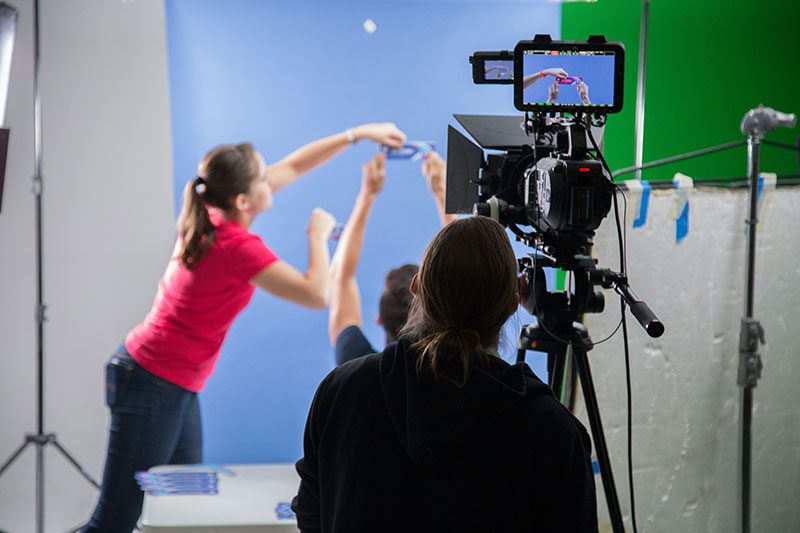
Storytelling is one of the most powerful ways to create engaging and interesting video content that truly resonates with your target audience. Stories help create an emotional connection with viewers and can be used to communicate your brand’s values, mission, and personality. Incorporating a narrative structure into your videos lets you capture your audience’s attention and keep them engaged until the end.
In addition, you can use storytelling to showcase how the product or service you offer solves a problem, making it easier for viewers to understand your offer’s value. Focusing on telling your story is a highly effective strategy for creating compelling and memorable videos.
Make Sure Your Videos are High-Quality
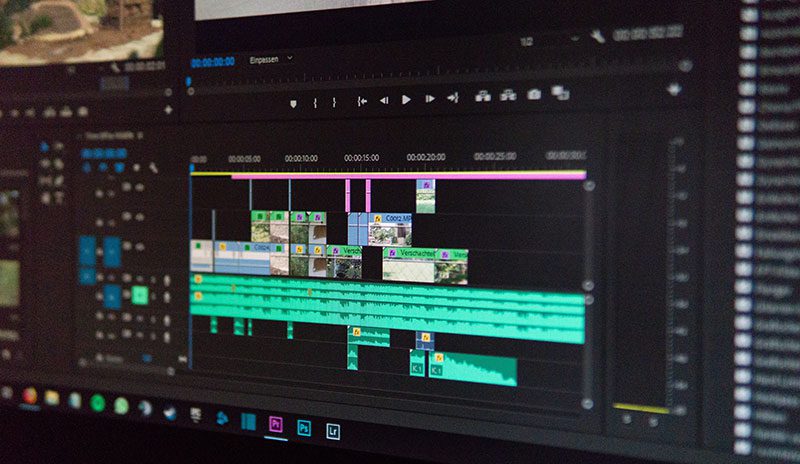
For your video content marketing strategies to be effective, they must be created with the highest quality possible. Poor production value or sound quality can turn off viewers and prevent them from engaging with your content. Investing in high-quality equipment and hiring experienced videographers or editors can help you create videos that look and sound professional.
Furthermore, paying attention to lighting, framing, and sound quality can significantly affect your videos’ overall quality. Creating high-quality videos increases your chances of engaging your target audience and achieving your video marketing goals.
Optimize Your Videos
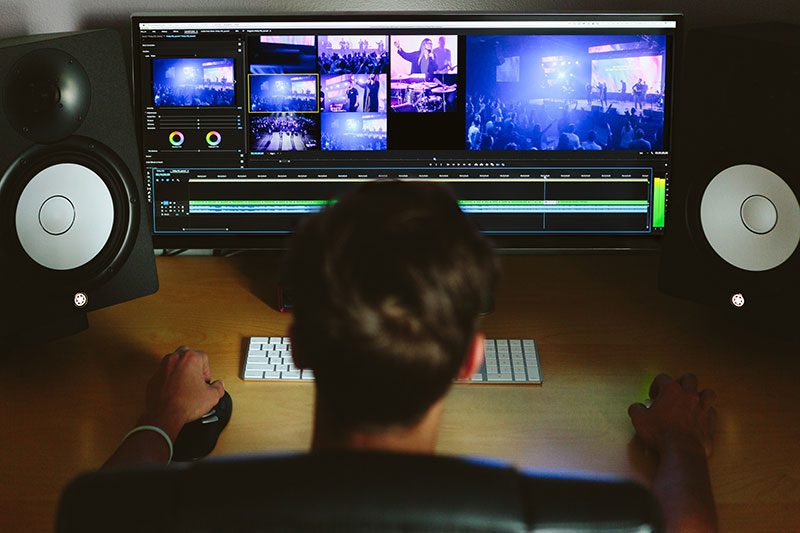
Optimizing your videos for search is essential to a successful video content marketing strategy. This ensures your videos are primed for search engines and social media platforms and that your target audience discovers them.
Some key elements to consider when optimizing your videos include adding relevant keywords to your video titles, descriptions, and tags, creating eye-catching thumbnails that accurately represent your video’s content, and including a clear call-to-action (CTA) to encourage engagement and conversions.
Another vital factor to consider when optimizing your videos is platform-specific optimization. Different platforms have different video length requirements and specifications, so you must optimize your videos accordingly. You may also need to adjust your video’s aspect ratio and resolution to ensure that it displays correctly on different devices.
Leverage Social Media
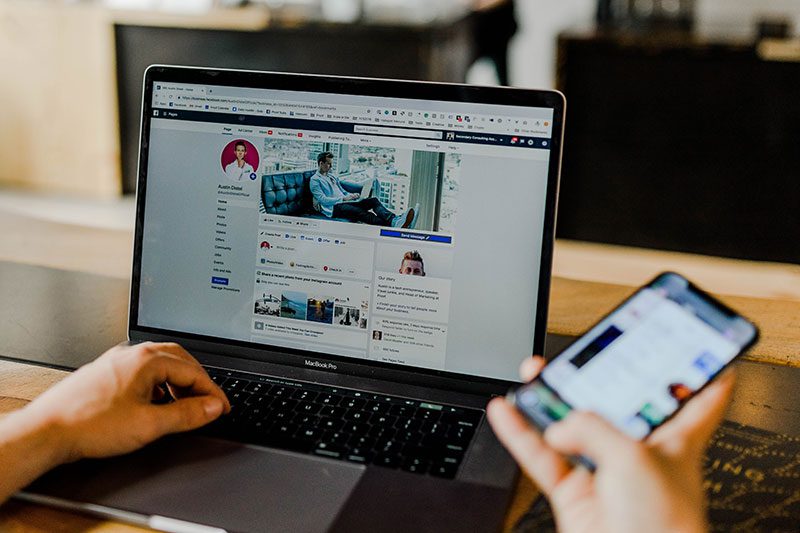
Social media platforms provide an opportunity to reach a large and diverse audience and can be used to promote your videos and increase engagement. To effectively leverage social media for video content marketing, it’s essential first to identify the most relevant platforms for your target audience.
Once you’ve identified the relevant platforms, you can create a social media marketing plan that includes posting videos at optimal times, engaging with your audience through comments and messages, and sharing your videos across multiple platforms.
In addition to organic social media promotion, you can also consider paid social media advertising to increase the reach and engagement of your videos. Platforms such as Facebook and Instagram offer highly targeted advertising options that let you reach specific demographics and interests. Doing so can increase the visibility of your videos and attract new viewers to your brand.
Measure and Improve Your Video Content
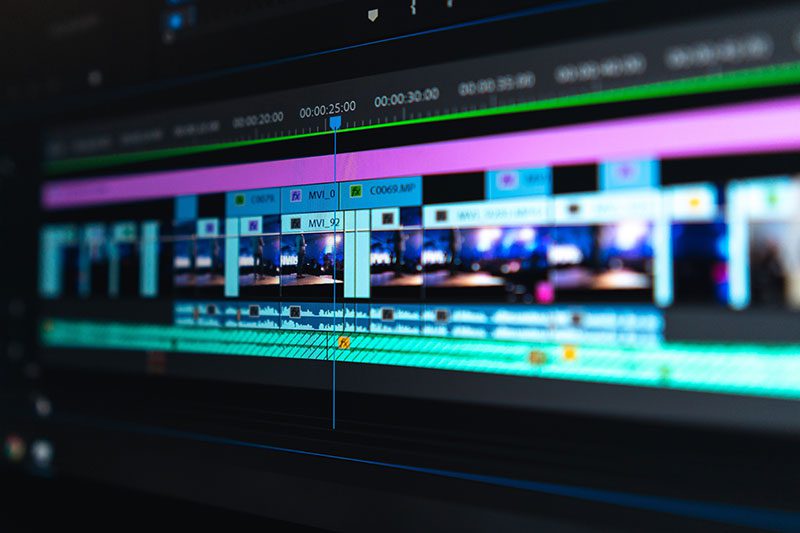
To ensure you’re on the right track with your video content marketing strategies, you need to measure and constantly improve them. One sure way to measure the success of your videos is by analyzing key performance indicators (KPIs) such as views, engagement, and conversions. This can provide valuable insights into what’s working and what’s not, allowing you to refine your strategy and improve the effectiveness of your videos over time.
Once you’ve analyzed your video’s performance, you can identify areas for improvement and make changes to your video content and distribution strategy. You may need to adjust your video length, tone, or messaging to resonate better with your target audience. You may also need to experiment with different video types or formats to see what performs best. Remember, don’t be afraid to experiment and explore.
Final Thoughts
With the power to engage and convert viewers, video content can help brands stand out in a crowded marketplace and build lasting connections with their target audience. By embracing video content marketing strategies, brands can stay ahead of the competition and drive long-term business success.


Unlimited graphic design services have become the go-to services of major brands like Uber, Buffer, 7/11, and more! You can follow in their footsteps by subscribing to an unlimited graphic design service since it allows businesses to scale anytime. Plus, it offers quick turnaround times without compromising quality. Besides those, it has a money-back guarantee and lets users cancel anytime without hassle.
If you can’t pick the best service, we have your back with this comprehensive list of the best unlimited graphic design services!
Which Provider Should You Choose?
We’ve done the homework and curated a list of Unlimited Graphic Design providers for you and also negotiated special deals on your behalf. You can see them all below and decide which one fits your business based on your needs.
Unlimited Graphic Design Providers
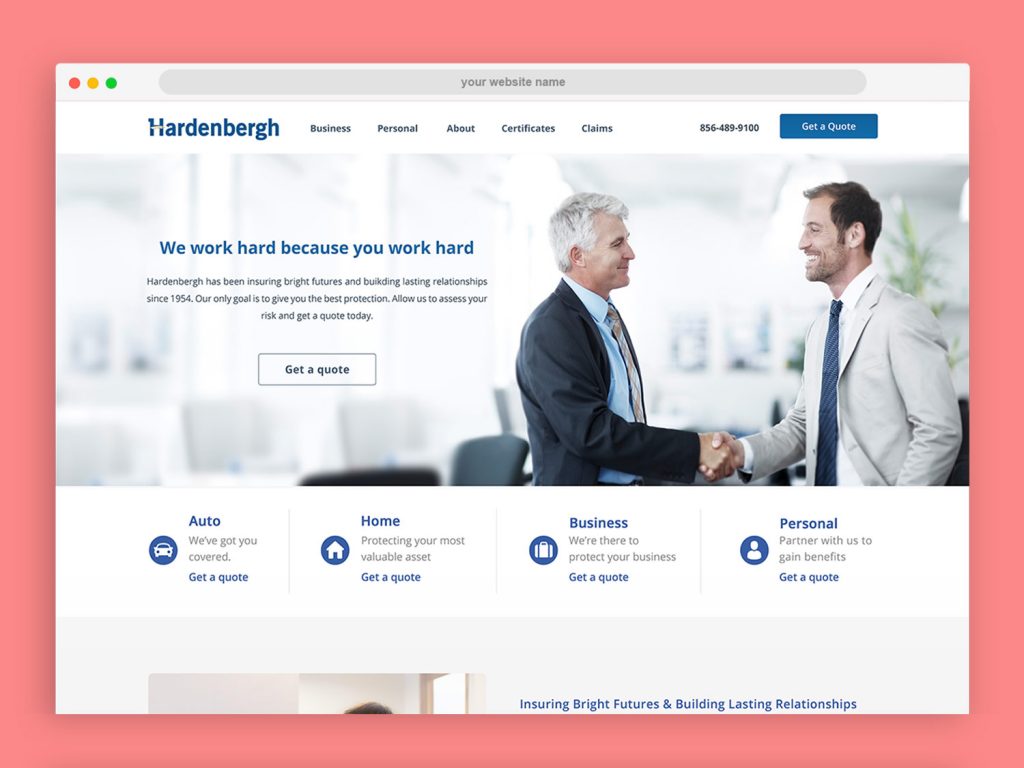
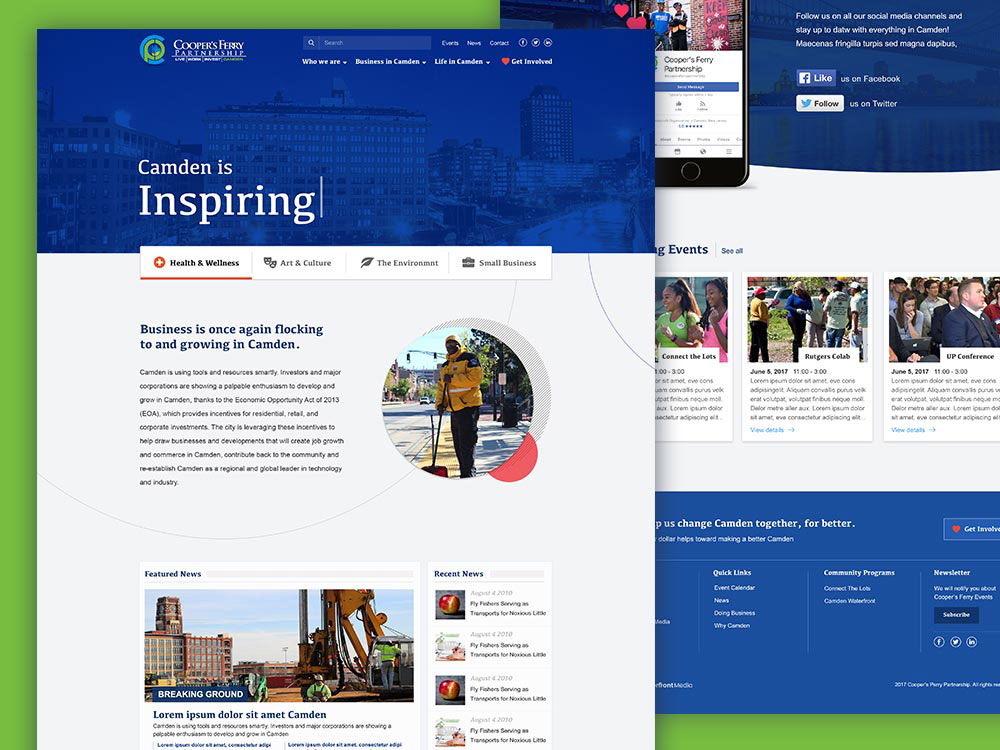
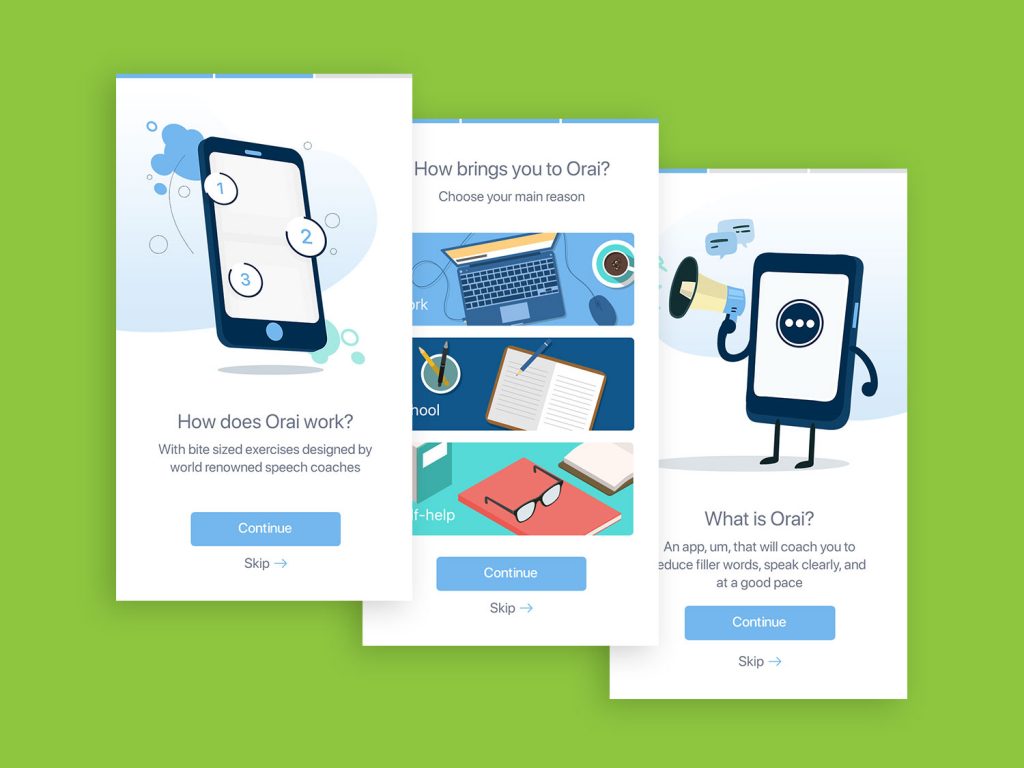
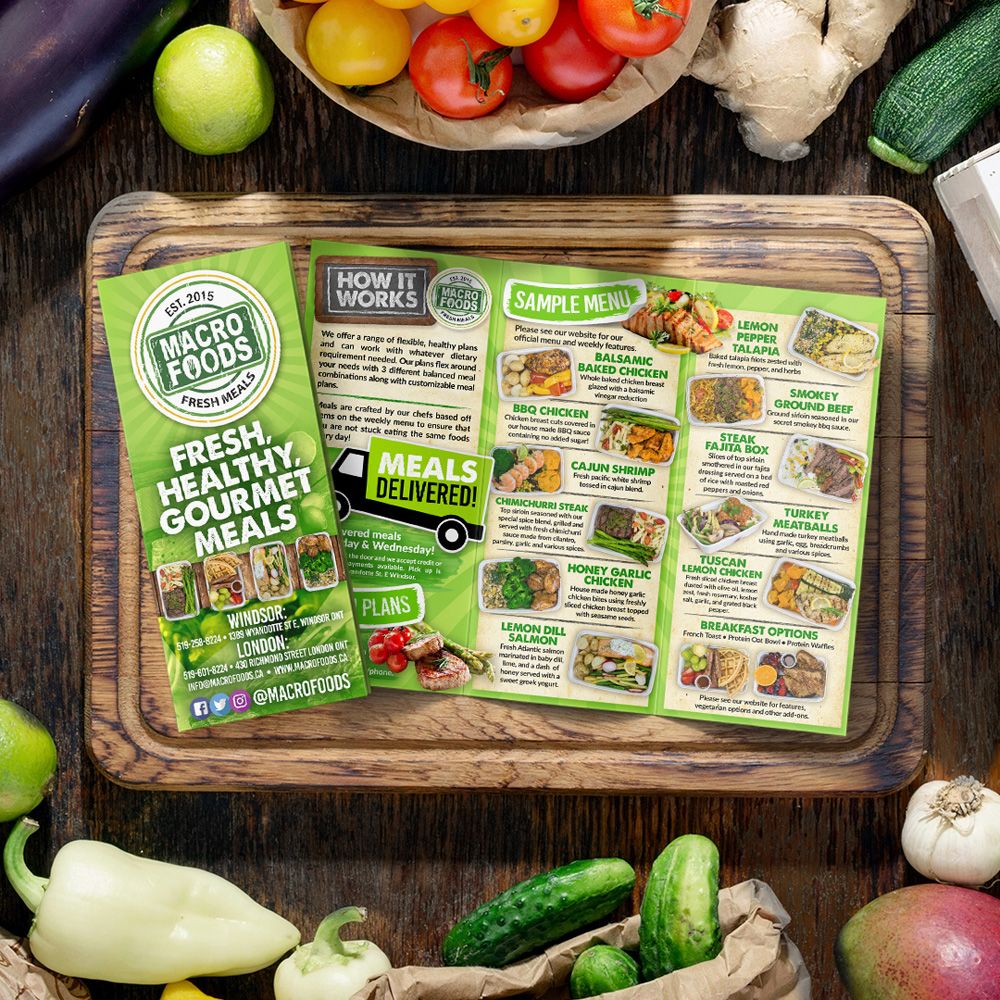
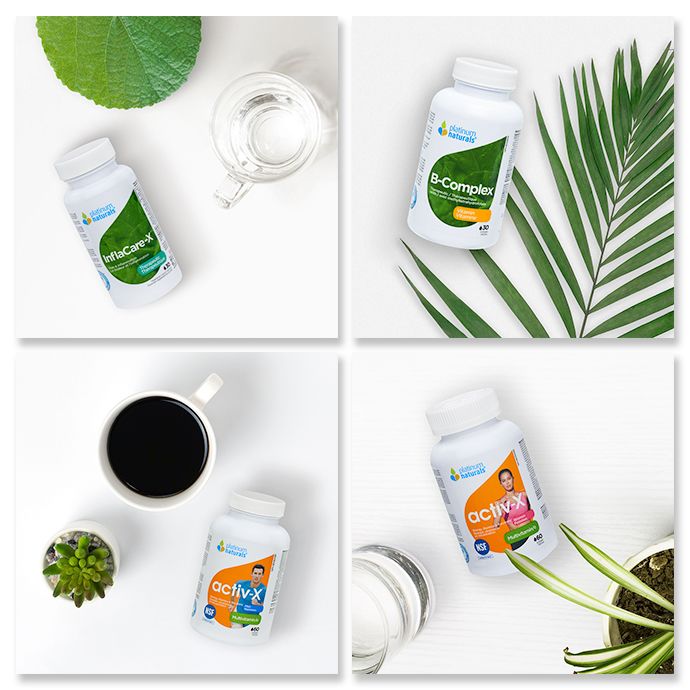
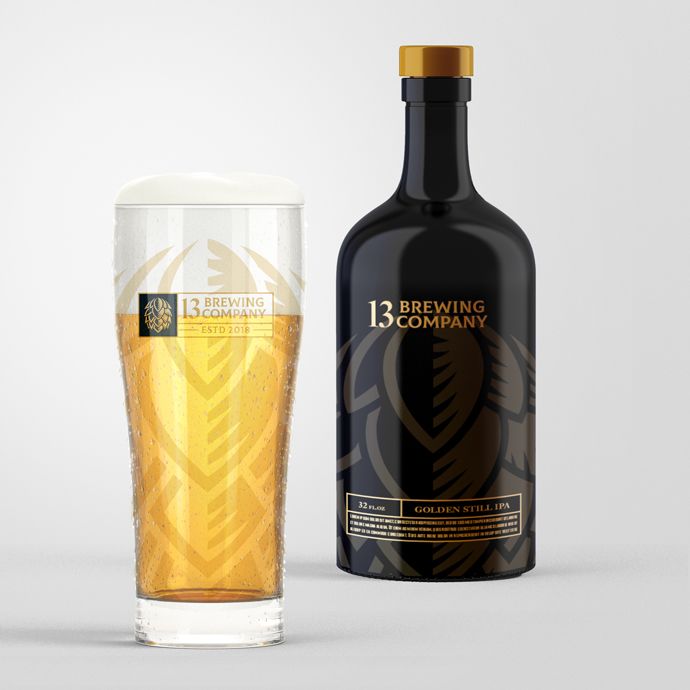
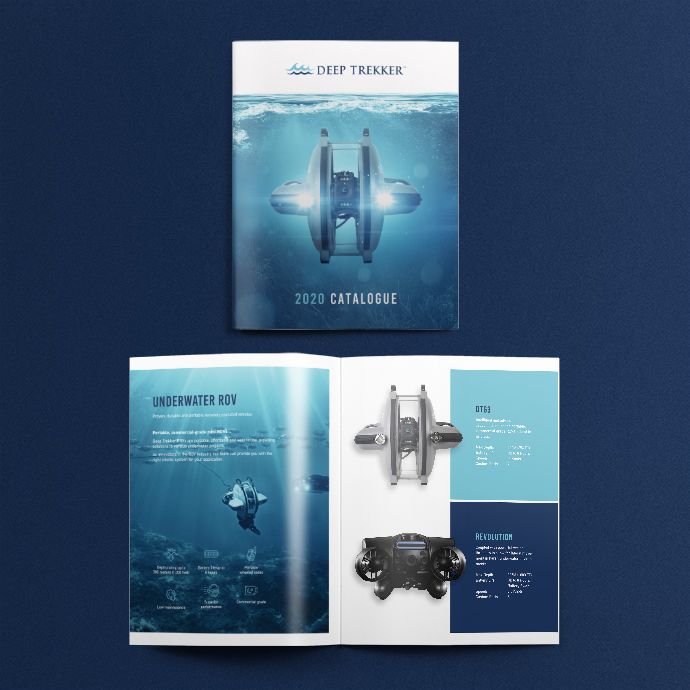
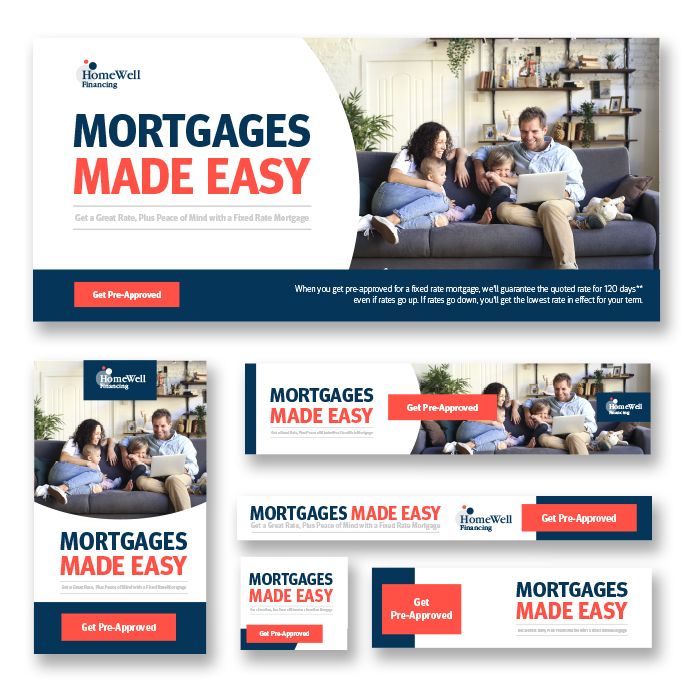

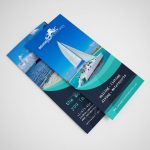
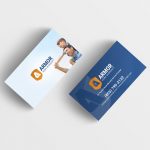


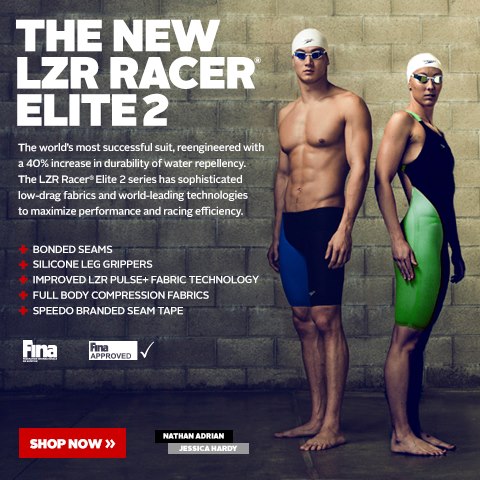
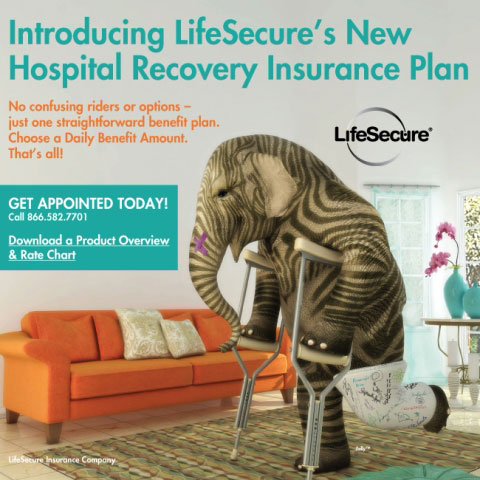
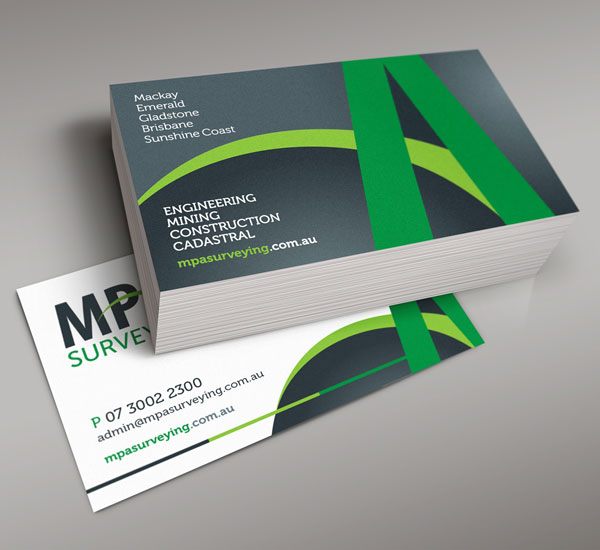



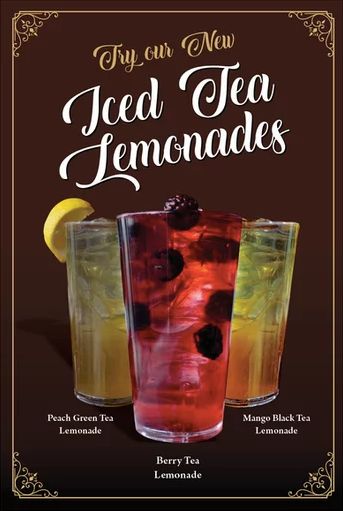

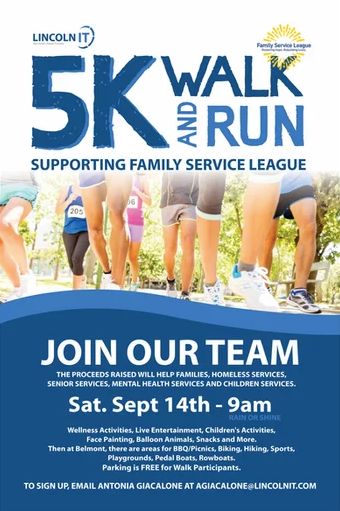
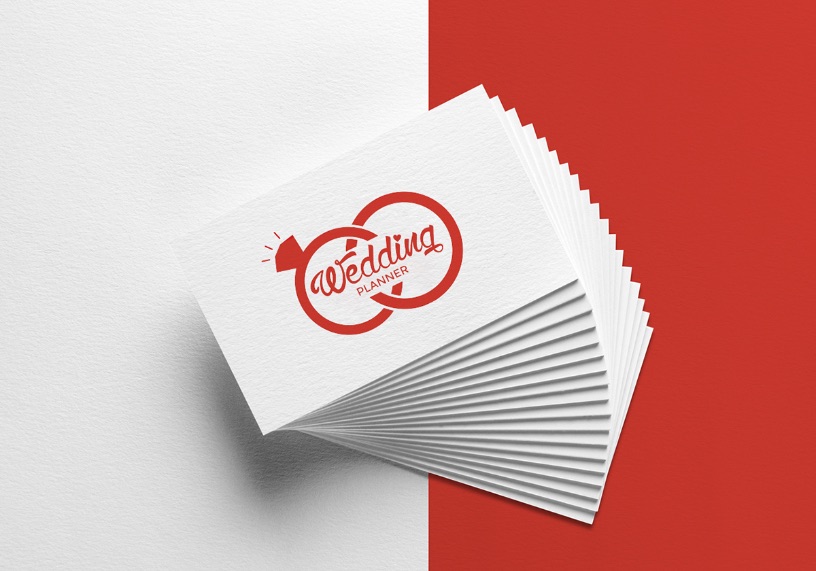
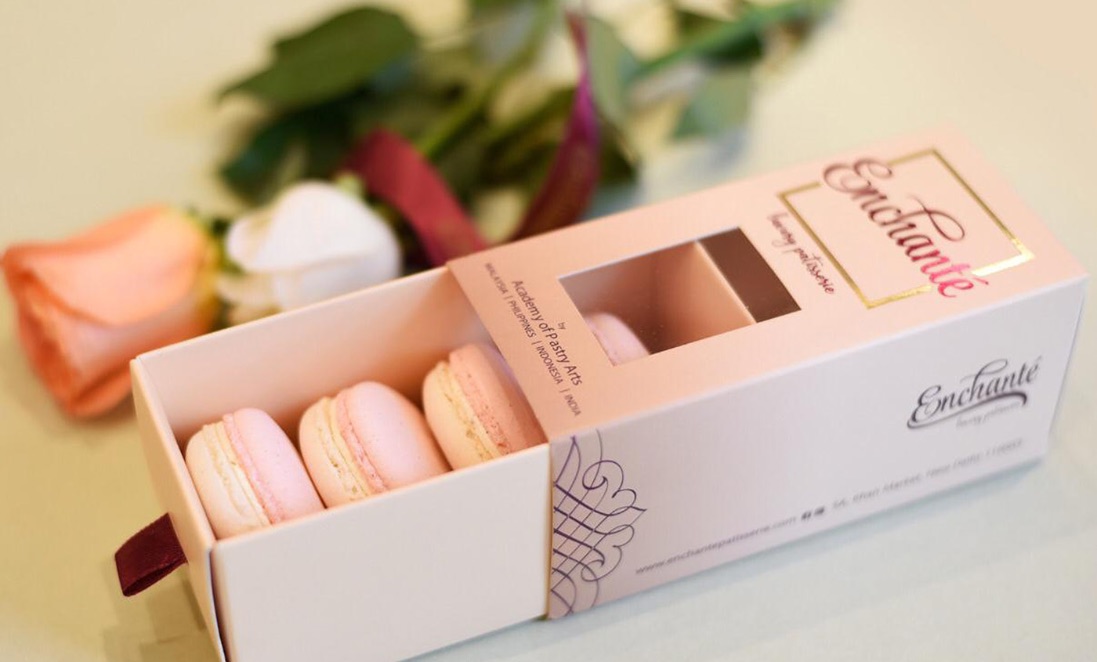
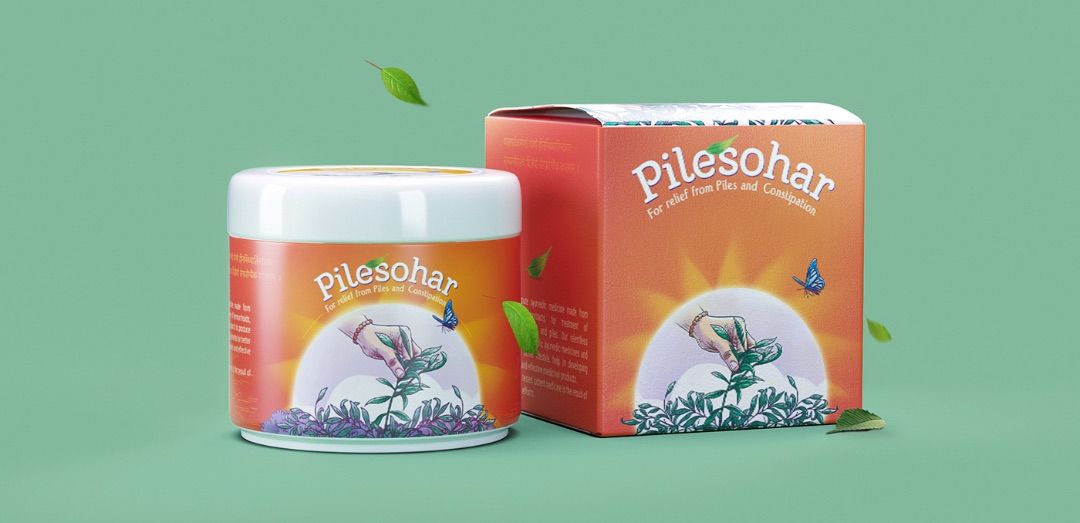
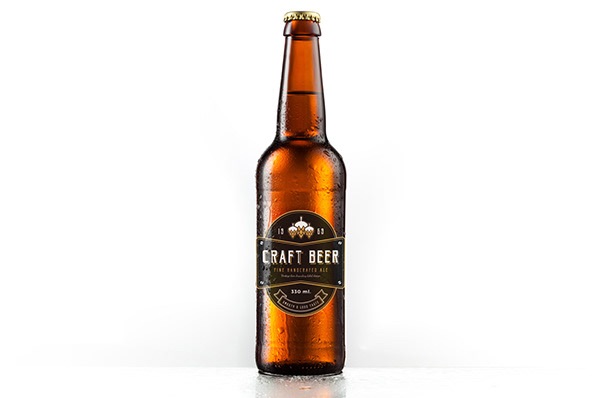
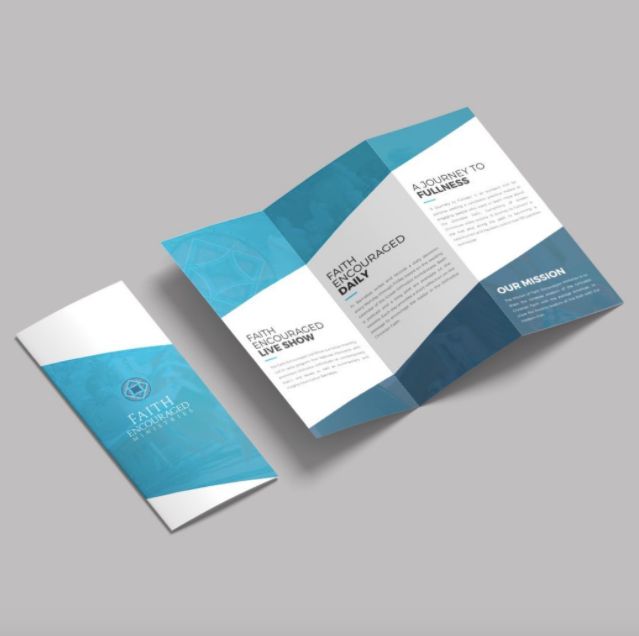
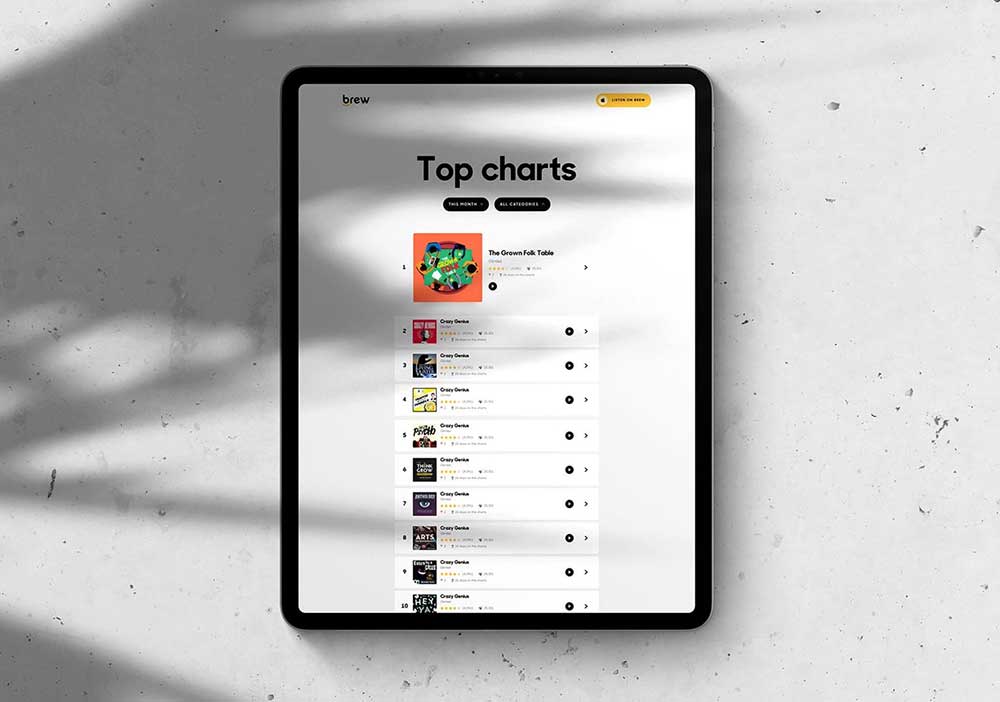
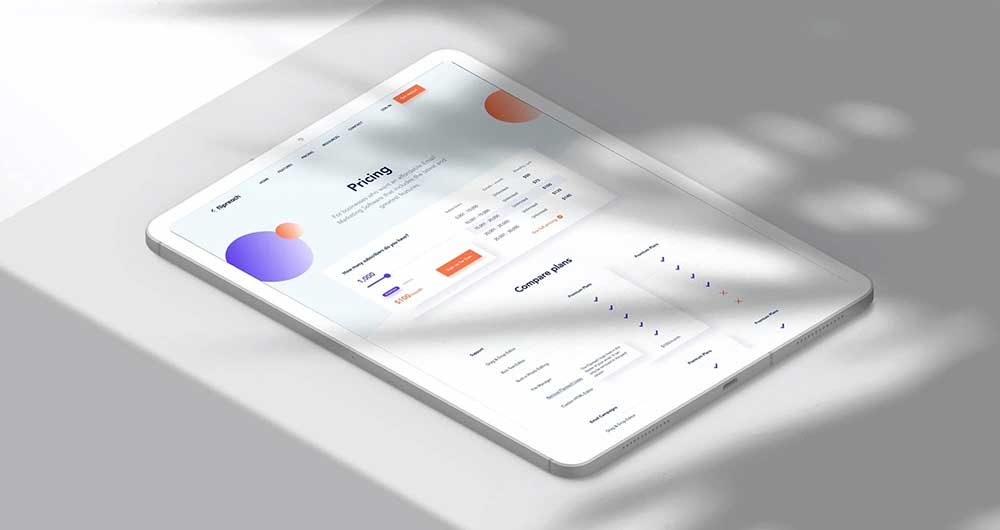


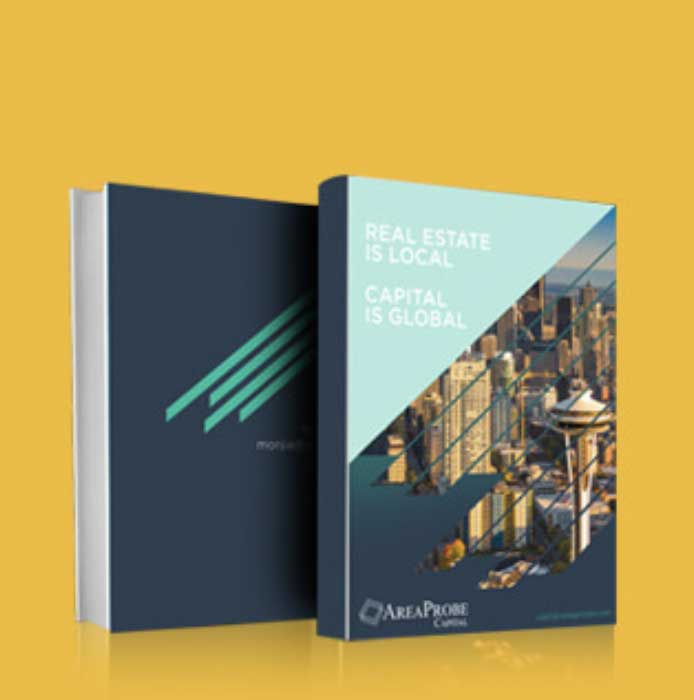
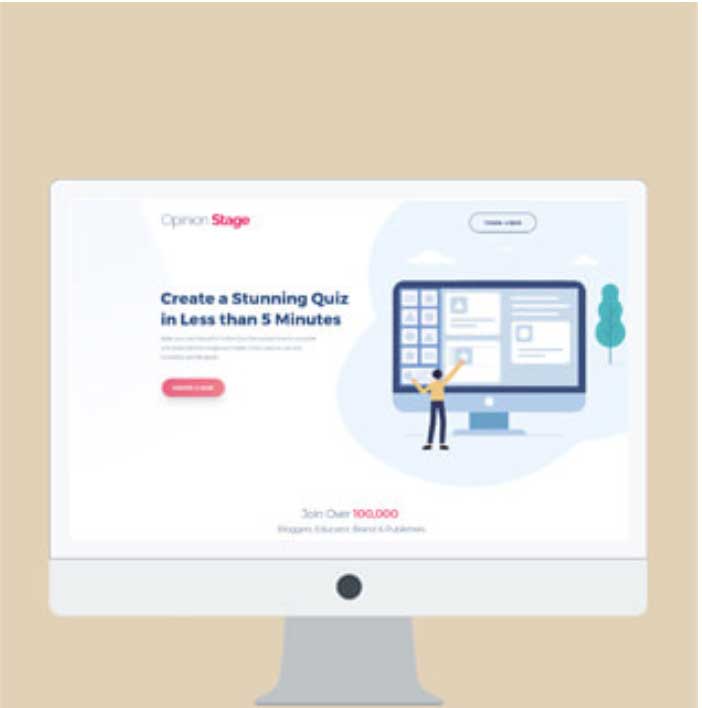
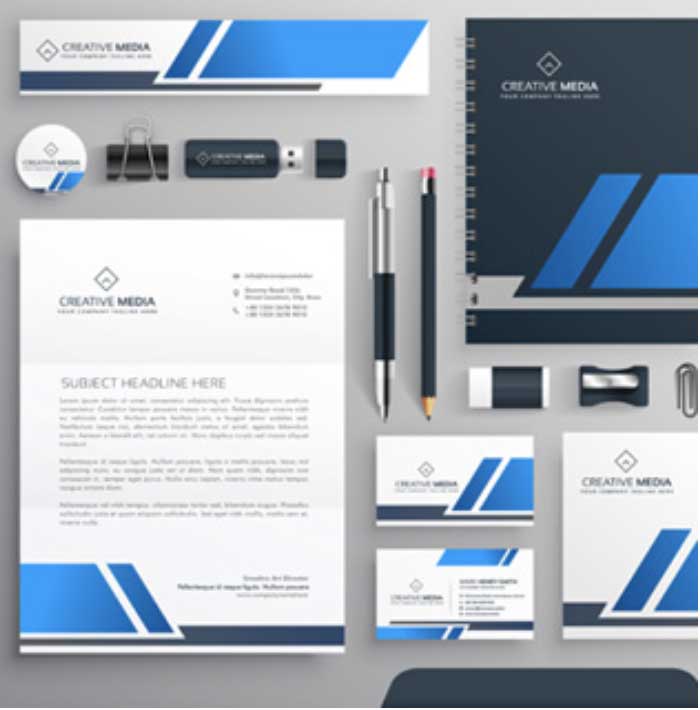

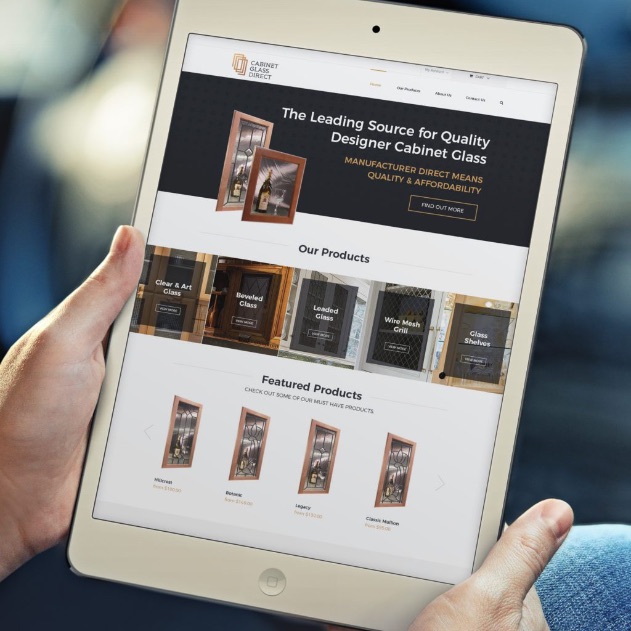
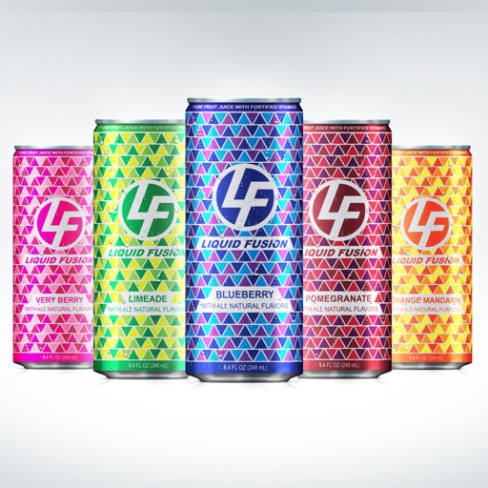
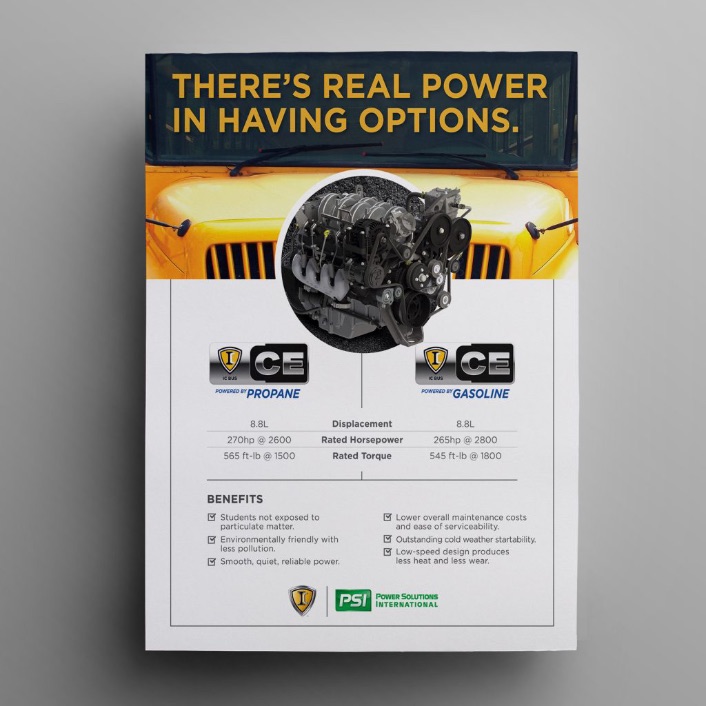
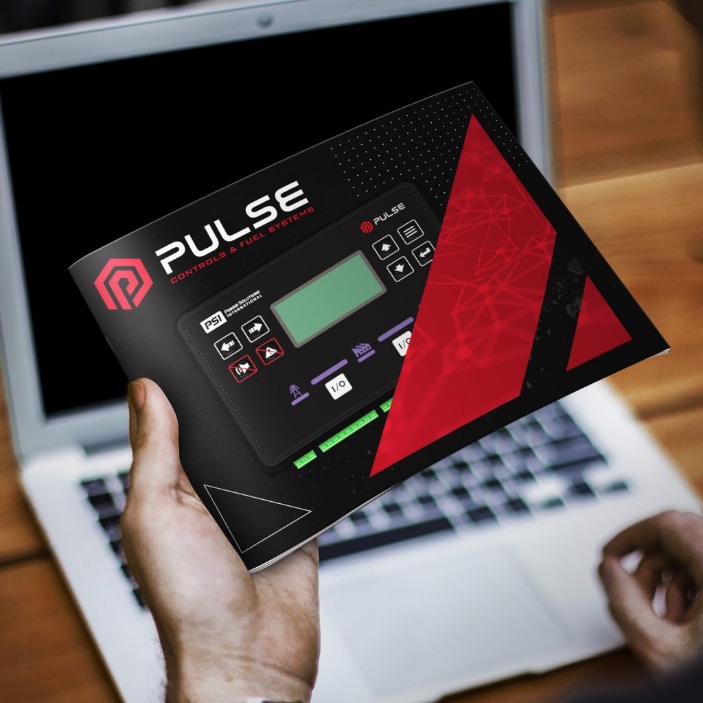




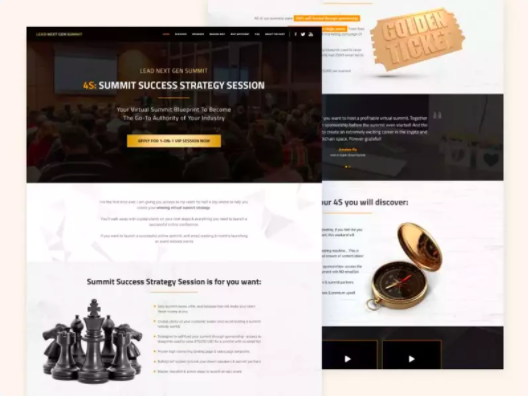
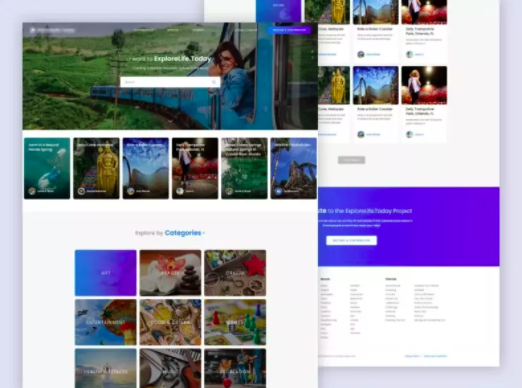
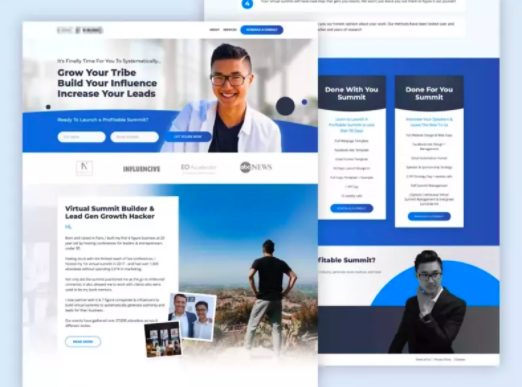
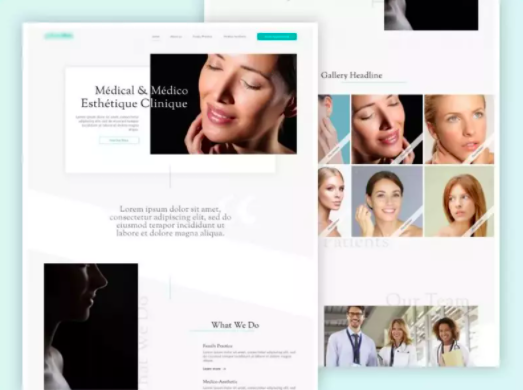















What Does Unlimited Graphic Design Mean?
These unlimited graphic design services have a monthly subscription business model. That means you can sign up and cancel whenever you like. What sets them apart from your typical freelancer, agency, or in-house designer is you gain access to a workflow that is designed to be quick and to the point.
You’ll communicate with their team through Trello, email, or an online platform. The option given is dependent on the company you choose. For example, only a small selection of services provide a custom built online platform for their customers.
Once you’re connected to their workflow, you can begin submitting as many design requests as you want. Although they all claim “unlimited”, it generally means you can “create” unlimited design requests. It doesn’t necessarily mean they’ll work on them all at once. Usually, they just work on one design at a time. When one completes, they start the next design.
The usual turnaround time is between 1 – 2 days, and that’s just for the first draft. It doesn’t mean your entire request is complete. If you don’t like it, you can request as many revisions as you want, and that will take more time. So it can take up to a week to actually get the design complete if you have a lot of revisions.
Another thing to keep in mind is content. You need to be able to have everything ready and provide all the content needed in order for their designers to get started.
How Does On-Demand Graphic Design Work?
Most graphic design services listed above offer clients a bespoke design platform. For instance, Penji’s design tool is an all-in-one platform where designers, account managers, customers, and their team members can communicate and collaborate.
Although the steps in working with a graphic design company are similar, we’ll use Penji’s design software to share the step-by-step graphic design process.
1. Log in
Once you’ve selected the subscription plan, log in to your design tool and access your dashboard. Most of these tools are user-friendly with a minimal learning curve and prioritize user experience.
This example of Penji’s dashboard shows a list and thumbnails of ongoing design projects. The menu at the top shows the Active, Completed, Drafted, and On-hold projects.
Submitting a design brief is the first step in the on-demand graphic design process. To submit, click the +New Project button at the upper right side of the dashboard.
2. Fill in the title
Think of a relevant project title that will describe the design accurately. Writing an accurate title will make browsing through ongoing projects easier once you have a long list.
For instance, if you’re creating a company logo, you can write “Logo design” and specify the company or industry beside it if you’re handling multiple brands.
3. Choose from design categories
The next step is to choose from the many design categories. Most unlimited graphic design services have around 100+ design categories. Penji has 120+ design categories. Choose one that fits your project.
4. Write a design brief
This step is crucial when working with on-demand graphic designers, as this will make or break your project outcome. Writing a thorough, clear, and well-thought-out design brief makes it easier for designers to understand exactly what you want.
Penji’s design platform has a few reminders on the left side when writing design briefs. Ensure you follow the tips for a better design outcome.
5. Attach files and images for inspiration
Some customers can’t express themselves clearly through written instructions. You can attach files and images to support your written descriptions with visuals. Attaching sample logos also helps lead designers in the right direction. Attaching your competitors’ logos is also a way to make yours better.
You’ll also need to choose the source file type in this step or let designers pick for you.
6. Choose a brand style guide
Subscribing to unlimited graphic design services means you can request any visuals for multiple brands. Penji’s design tool lets you save and categorize your brand style guides in folders. This way, you only have to choose a branding guideline for designers to follow.
Once you’ve chosen the associated brand, click the Create project button to start the process.
7. Wait 24 to 48 hours
Although most on-demand graphic design services’ turnaround is 24 to 48 hours, some companies may take more than two days. This is due to complex projects like illustrations or web pages.
Wait for the first draft and ask for revisions until you’re 100 percent happy with the design. Download the source file, and you’re good to go!
Why Should You Sign Up for Unlimited Graphic Design Services
Subscribing to unlimited graphic design services is more convenient than hiring freelance designers. Here’s why:
- Work with vetted designers and choose from various skill sets. There is no need to search for another designer fit for a particular project. The company will assign you the most suitable designer.
- No need to worry about additional fees as you only have to pay fixed monthly rates and get unlimited designs. Revisions also come at no extra cost.
- You don’t have to worry about graphic designers going MIA and abandoning crucial projects. Each design project is managed by an account manager who will check if deadlines are met on time.
- Signing up and canceling subscriptions with on-demand graphic design services is easy. You can sign up if you need a stream of designs while setting up shop and cancel anytime without incurring cancellation fees.
- Fast 24 to 48-hour turnaround, which prevents any bottlenecks in your marketing campaigns.
- Request to change assigned designers if you’re unhappy with their work at no additional cost.
- Organize your projects and brand style guides if you request multiple brand designs. The custom design platforms make managing projects efficient and convenient.
Are they worth it?
If you have a lot of design needs, they’re definitely worth it. Being that it’s a monthly recurring investment, you’ll need to make sure that you have the need for an ongoing graphic design service. This graphic design service model is comparable to outsourcing a designer yourself, except much of all the management work is done by the company. The quality of designs and turnaround time also tends to be significantly better when outsourcing a designer yourself.
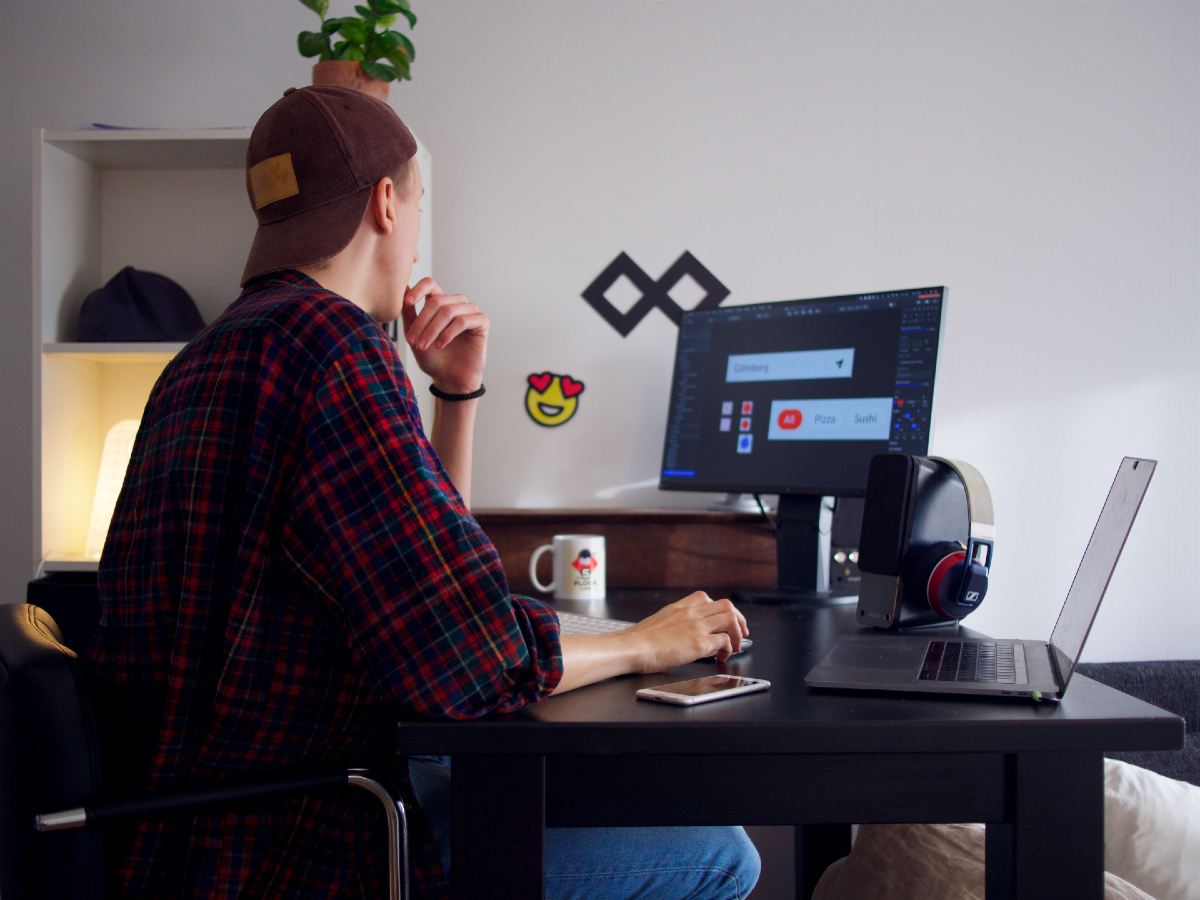
Due to the increased demand for affordable graphic design, various unlimited graphic design services has been popping up online. The graphic design industry expanded, offering more options to clients.
We can say that the scene is more competitive now than ever. However, let’s focus on Graphics Zoo for this article. We weigh in on if their services can keep up with the fierce competition in the “unlimited” section of the industry.
What is Graphics Zoo?
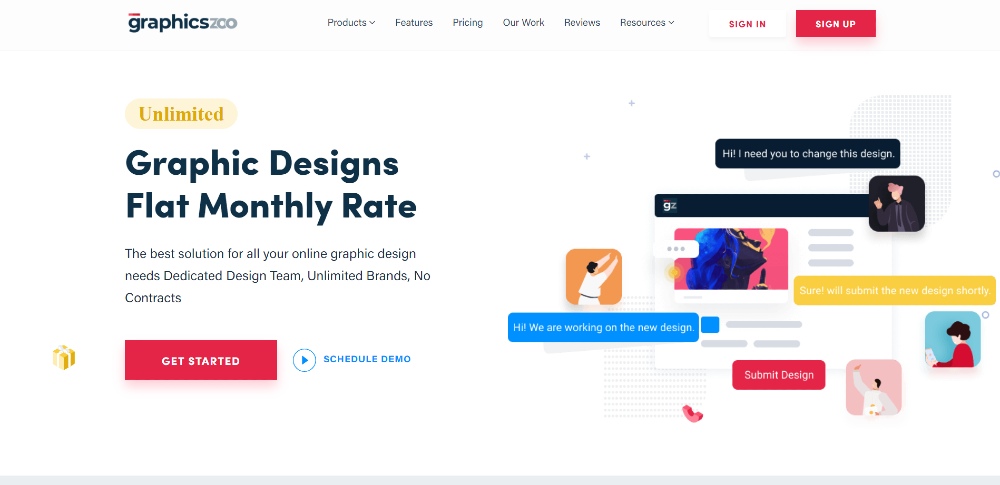
Graphics Zoo is an unlimited graphic design service that allows users to request designs on a monthly subscription. All clients have to do is create a submission with full specifications of their design requirements.
It’s also best to attach references to help designers take the creative path towards the client’s preferences. The great thing about an online graphic design service is its flat monthly rate, with no added fees for revisions.
Graphics Zoo Business Model
Unlimited graphic design is a type of business model which allows clients to submit numerous requests per account. After presenting the design preference, expect a 24-hour turnaround or more before you can receive your output. If you receive a design output that’s far from expectations, you can point out the changes you want to make for the revision. Graphics Zoo has a flat monthly rate with no contracts involved. It means you can cancel your subscription anytime without having any legal worries.
You might also like: Design Pickle VS Penji Review
Graphics Zoo’s Market
The design service is excellent for startups, bloggers, and entrepreneurs. As long as the business needs a continuous supply of custom graphic design, Graphics Zoo is worth a shot. Here are a few examples of companies that worked with Graphics Zoo:
- Enicode
- Bread of Life Inc.
- Western Rockies Federal Credit Union
- Perfect Imprints
- Green Guard
According to their website, Graphics Zoo has more than 750 satisfied customers with at least 50,000 approved projects. It’s also highly rated by their customers, earning whopping 4.9-star reviews.
Pros and Cons of Graphics Zoo
Graphics Zoo Pros
- PROOF management system
Graphics Zoo offers a robust system that provides a collaborative space for designers and clients. It streamlines the whole submission and revision process. Using the tool, the clients can click on any submitted designs to pinpoint areas that need revision. It also allows users to leave a comment to provide more instructions to the designer.
- Graphics Zoo offers a stellar project management system that allows efficient communication between both parties.
- Brand profile features add accuracy and efficiency per design project. It quickly provides the design’s purpose to designers.
- Graphics Zoo offers a comprehensive design selection across various graphic design categories.
- The ability to share one account among multiple users is helpful for most businesses.
- Excellent customer support and design project management system
- A team of versatile designers that can provide designs for any business types
Graphics Zoo Cons
- It’s possible to encounter ill-paired designers that are not fit for other project requirements. It might consume time because of countless revisions.
- You can only have one ongoing project per day. So if you’re a business with a high design output demand, you should opt for a plan with more designers.
- Graphics Zoo’s system only allows you to chat with the designers. If you’re more inclined to video calls, it might be a problem for you.
Graphics Zoo’s Pricing Plan
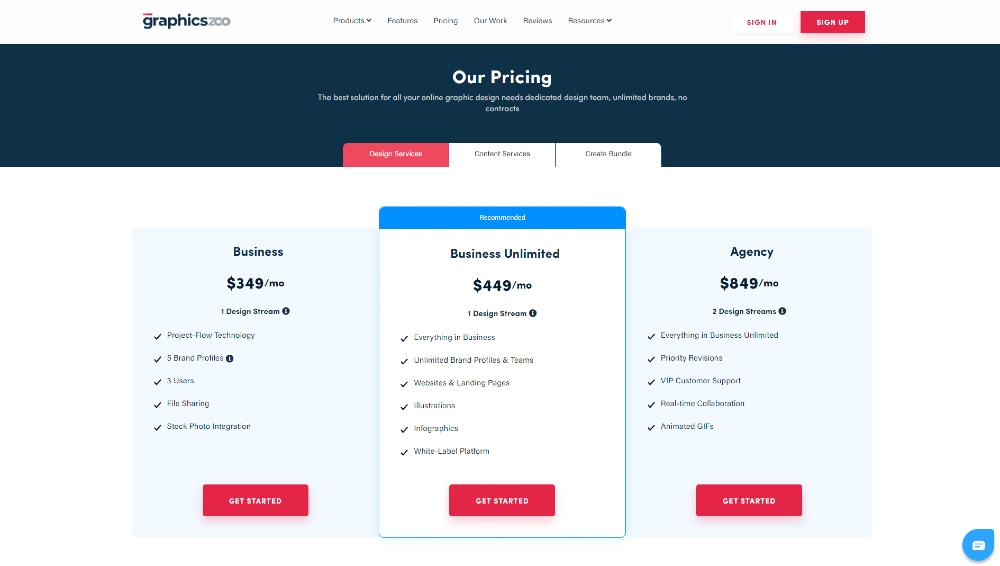
Graphics Zoo offers three monthly plans with robust features:
Business Plan
- $349 per month
- All basic features
- One dedicated designer
- Additional $349 for additional designer
- Five brand profiles
- Three users
- 14-day guarantee
Business Unlimited Plan
- $449 per month
- Everything included in the business plan
- Unlimited brand profiles
- Unlimited users
- White-label platforms
- Customized web design service
- 14-day guarantee
Agency Plan
- $849 per month
- Everything included in previous plans
- Two dedicated designer
- 30-day guarantee
- When starting a project with GraphicsZoo, making the most of their streamlined and user-friendly platform is crucial. Here are some key strategies for a successful collaboration:
- Use Slack for direct communication with your designer. This allows for instant feedback and praise, ensuring clear and efficient revisions or approvals.
- Prioritize clear and detailed communication. Never assume your designer has implicit understanding of your needs. Be explicit in your project briefs, and don’t hesitate to share comprehensive information about your brand and objectives.
- Remember, effective communication is as vital with your design team as it is in any other part of your business. The clarity and detail of your interactions can significantly influence whether the final design meets your expectations or falls short.
- By following these guidelines, you can foster a more productive and satisfying partnership with GraphicsZoo, leading to designs that perfectly embody your vision.
Tips for GraphicsZoo Users
When starting a project with GraphicsZoo, making the most of their streamlined and user-friendly platform is crucial. Here are some key strategies for a successful collaboration:
- Use Slack for direct communication with your designer. This allows for instant feedback, ensuring clear and efficient revisions.
- Prioritize clear and detailed communication. Never assume your designer has implicit understanding of your needs. Be explicit in your project briefs, and don’t hesitate to share comprehensive information about your brand and objectives.
Other Unlimited Graphic Design Companies
If you’re looking for more options with a similar business model as Graphics Zoo, we did the work for you. Here is our full list of unlimited graphic design services.

Investing in the best graphic design partner to help you fulfill your graphic design goals for multiple reasons, like branding, marketing, and advertising, is important. As such, you want a trusted design service to collaborate with and help you with your graphic design work. You don’t have to look further because we list the top five highest-rated design services!
Before we list them, know our criteria when choosing the top five.
- The design service should have over 100+ reviews combined on various review sites, like G2, Trustpilot, Google, Product Hunt, and Facebook.
- It should cover various design work, such as logos, marketing assets, web designs, and more.
1. Penji
Average rating range: 4.7 to 4.8
One of the most trusted design services by big brands and agencies is Penji. Over 25,000 brands and agencies trust the company for design work!
The unlimited graphic design service has a dedicated Agency plan to streamline design production. Agencies rely on Penji to help them manage various client projects. Plus, they can access motion designs, work with an art director and Figma web designer, and have unlimited storage space and users.
Agencies that have worked with Penji say they are the ideal design partner and are responsive to questions and projects. Plus, Penji has helped agencies meet deadlines because of the turnaround times.
Similarly, big brands can leverage the Agency plan to double their output. But the Marketing and Starter plans are available to help you with branding, illustrations, ad creatives, web designs, and presentation designs! Uber, Lyft, and Best Buy have partnered with Penji for their graphic design work!
Read our review of Penji here and get 25% off when you subscribe to the unlimited graphic design service!
Pricing:
- Starter – $499/mo
- Marketer – $995/mo
- Agency – $1497/mo
2. Flocksy
Average rating range: 4.6 to 4.8
Flocksy is another agency favorite since the design service offers various creative solutions. However, agencies and big brands can benefit from requesting over 70+ designs in one subscription for graphic design work.
Agencies and big brands can choose between the Gold and Platinum plans, depending on how fast they want to receive the output or how many projects a creative should work on in a day. Regardless of your agency or brand’s plans, you’ll also get copywriting and custom illustrations. However, the higher the plans, you can get video editing, voice-over and audio, motion graphics, and logo and branding guides.
Agencies that have worked with Flocksy say that they can finally delegate design work to designers. Plus, Flocksy helps them scale their agency.
The design service has helped clients since 2016, including big brands like American Airlines, Harley-Davidson, and State Farm!
Pricing:
- Silver – $499/mo
- Gold – $995/mo
- Platinum – $1695/mo
3. ManyPixels
Average rating range: 4.4 to 5.0
Another trusted design service is ManyPixels. The design service has served over 3,000 clients and completed over 150,000 designs! ManyPixels has worked alongside Teachable, Buffer, and Decathlon to help with design work.
Agencies and big brands can benefit from the Business and Designated Designer Plans. The Business plan doubles the output but has a 1 to 2-day delivery. Meanwhile, the Designated Designer plan allows you to collaborate with a designer in real time. Additionally, motion graphic design is available in this plan. Plus, they promise same-day delivery, too!
Some agencies prefer ManyPixels because they offer more affordable rates than in-house designers with the same or twice the output.
Pricing:
- Advanced – $549/mo
- Business – $899/mo
- Designated Designer – $1,199/mo
4. Kimp
Average rating range: 4.1 to 4.9
If you need video editing work on top of graphic designs, Kimp should be one of your top design service choices. However, if graphic design is your only need, you can get the most out of Kimp’s Graphics plan. Unlike other design services, Kimp doesn’t have a same-day turnaround time. But, the Graphics plan includes all graphic designs you can think of.
Kimp specifically has agencies in mind. That said, their agency partners believe that Kimp is an extension of their company and helps them get back on track.
Universal Music, Decathlon, and Single Grain have become their partner brands to help them with designs or videos.
Pricing:
- Graphics – $599/mo
- Graphics + Video – $995/mo
5. Design Pickle
Average rating range: 4.1 to 4.7
Last but certainly not least is Design Pickle. Agencies and brands have three plans to choose from when receiving graphics from Design Pickle. However, they can take advantage of the Graphics Premium plan, allowing them access to graphic design, illustrations, presentations, and motion graphics. They promise same-day turnaround times, but complex projects could be delivered the next day. Additionally, agencies and brands can talk with Design Pickle in real time through Slack.
Agencies say that working with Design Pickle helped them deliver their work timely. Plus, they believe the plans are more affordable than hiring a freelancer or an in-house one. As for brands, Design Pickle has worked with 7-11, Yahoo!, and Amazon for design work!
Pricing:
- Graphics – $649/mo
- Graphics Pro – $1249/mo
- Graphics Premium – $1949/mo
What Makes Unlimited Graphic Design Services the Top Choices?
Our top five list has one thing in common. They’re all unlimited graphic design services.
They are cost-effective solutions, providing one flat rate for all design work. You don’t have to pay hourly or per project! Additionally, you can consider graphic design services as an extension of your creative team or business! You don’t need to hire employees anymore, too. Unlimited graphic design services have a rigorous vetting process, hiring only the cream of the crop.
Some offer a risk-free trial or money-back guarantee, allowing you to try them before fully committing. You can also scale your business through various subscription plans. Moreover, you can cancel your subscription anytime! Plus, you don’t have to worry about paying for revisions since they have unlimited revisions!
Finally, you don’t have to worry about freelancers submitting their work late since graphic design services guarantee a 1 to 2-day or same-day turnaround time! Plus, graphic design services hire project managers or art directors to check designer work before submitting it to you!
Why Choose Graphic Design Services?
Graphic design services are a much more affordable and cost-effective solution. Here are reasons why you should choose graphic design services.
1. Saves You Time
Hiring freelancers takes days, even weeks to decide on the ideal employee to take on your design projects. You can save time by finding a graphic design service like an agency or subscribing to an unlimited graphic design service. These services have already done the vetting, which helps you cut the time needed to hire a freelancer. Plus, graphic design services have teams of designers on board, allowing you to change designers anytime when needed.
2. Choose Bundles or Subscribe to Plans
You can also save money by choosing a graphic design service instead of hiring freelancers. Some graphic design services offer packages or bundles to help you save money on branding or social media. Other graphic design services like the subscription model let you subscribe to plans and request multiple designs for a flat monthly fee! Plus, this model has unlimited revisions built into the plan. This means you don’t have to pay extra for revisions!
3. Partner with Reliable and Professional Designers
Since graphic design services do the hiring process, they ensure that designers working for them are reliable. Some freelancers have a bad reputation when working with clients. Graphic design services guarantee that you’ll communicate and work with amazing designers during your subscription or when your project has finished.
What Designs You Can Expect from Unlimited Graphic Design Services?
- Logos
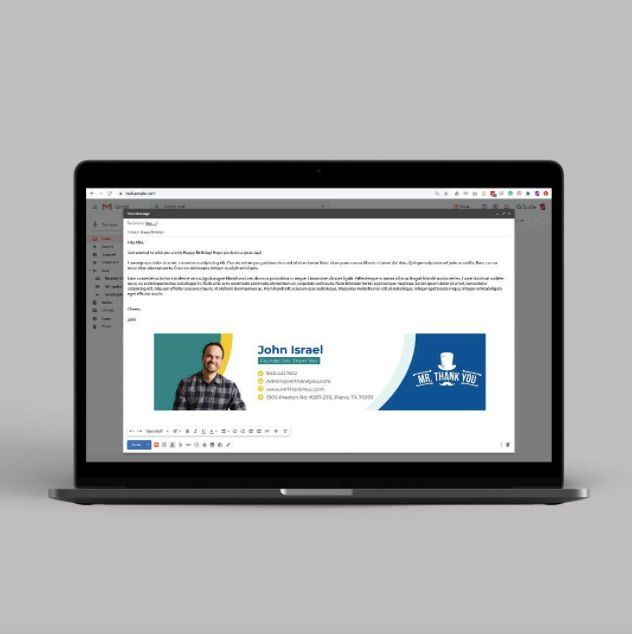
- Business cards
- Web and app designs
- Presentation designs
- Marketing materials
- Marketing designs
- Digital ads
- Billboards
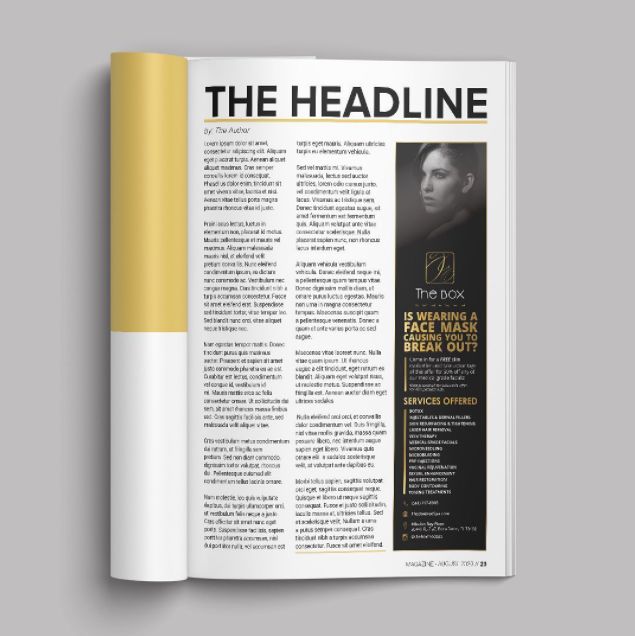
- Magazines
- Packaging
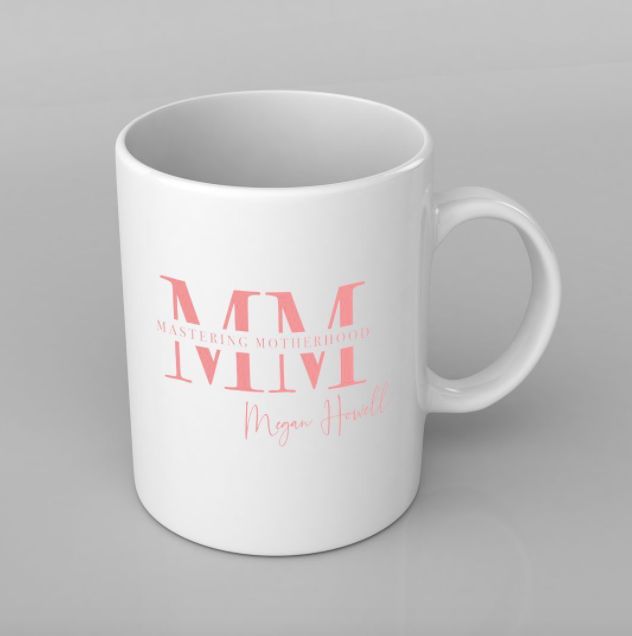
- Merchandise
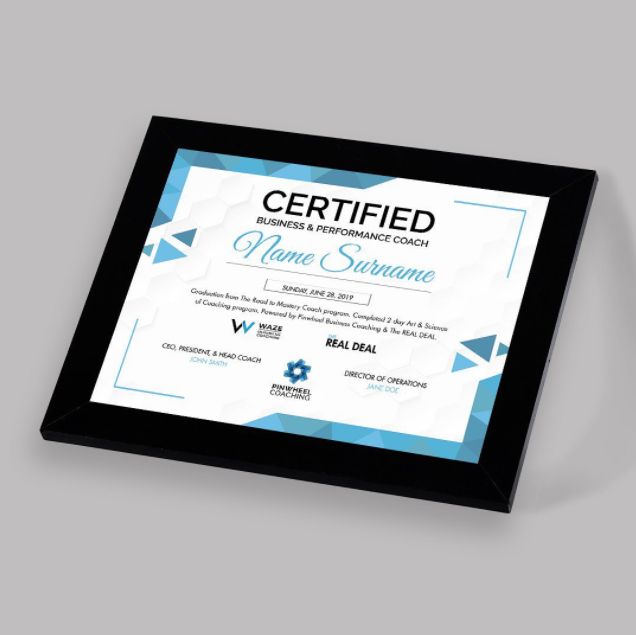
- Illustrations

Unlimited Graphic Design Companies Of 2023 + Promo Codes (Updated)

10 Best Banh Mi Restaurants In and Around Tulsa

99Designs: An Honest Review From a Non-Designer

Graphics Zoo Review: Is this unlimited graphic design service worth it?

5 Highest Rated Design Services Used by Big Brands & Agencies

The 3 Best Graphic Design Services to Try in 2024
