
Business
5 Highest Rated Design Services Used by Big Brands & Agencies


Finding a design partner that can elevate your brand’s visuals, strengthen your identity, and support your revenue growth is more important than ever. The challenge? Comparing design companies can feel like a full-time job. To save you time, we’ve rounded up the highest-rated design companies based on reviews from Trustpilot and Google—two trusted platforms where real clients share their experiences.
Let’s explore the highest-rated graphic design companies of the year and see what they offer so you can choose the perfect fit for your brand and budget.
1. Penji
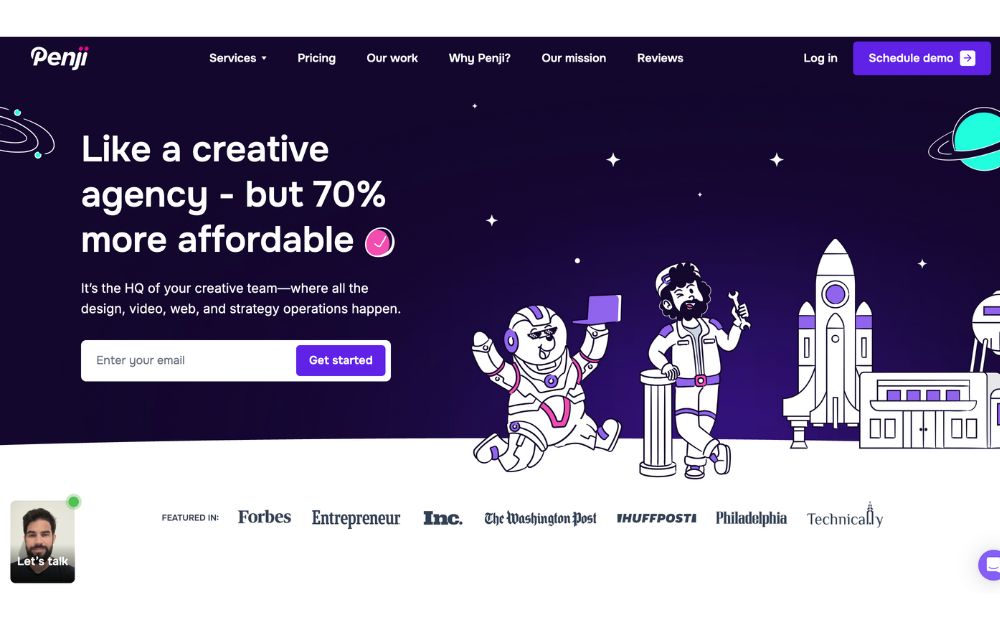
Trustpilot rating: 4.8
Google rating: 4.7
First on our list of highest rated design services is Penji. The platform’s business model is unique because it offers an unlimited graphic design subscription. You simply pay a flat monthly fee and get as many designs as you need for yourself or your clients. Their scope of service spans over 100 design categories, which means they can handle your website, branding materials, ad designs, packaging designs, and more. Agencies rely on Penji to help them manage various client projects and radically increase their design output if needed.
Penji has three plans to choose from, all of which are unlimited, but the details vary. In higher plans, you can access motion graphics and even work with an Art Director and a Figma Web Designer. The platform is user-friendly, making it easy to submit design briefs, collaborate with your team, and contact your assigned designer directly.
Unlike some of the companies on this list, Penji has a dedicated design team. So if you don’t want to take a chance on freelancers, you can get to know Penji’s designers and who works best with you. Intrigued about Penji? Learn more from our review here.
What can you get from an unlimited graphic design service?
- Logos
- Business cards
- Web and app designs
- Presentation designs
- Marketing materials
- Marketing designs
- Digital ads
- Billboards
- Magazines
- Packaging
- Merchandise
- Illustrations
- Motion graphics
Pricing:
- Starter – $499/mo
- Marketer – $995/mo
- Agency – $1497/mo
2. Clay
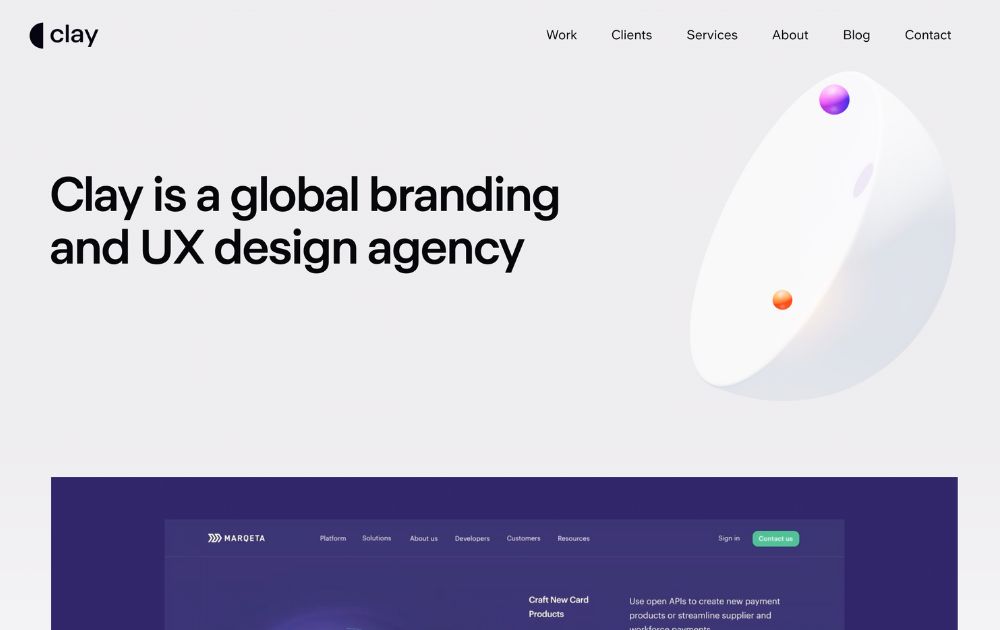
Google rating: 4.8
Also included in our highest-rated design services is Clay, a widely known and respected design agency that has worked with such names as Slack, Stripe, and Meta. They’re a full-service agency that specializes in branding, website design, and content creation. This is a diverse company that honed its creativity with past projects like a food app, a payroll management platform, an interior design website, and more.
Clay has a knack for covering all the details and ensuring they go all out for each project. Pricing is handled on a case-by-case basis as the company operates like a traditional full-service design agency. They’re a great option for brands with larger budgets who have specific projects they want to accomplish – eg, rebrands, app builds. They also offer art direction and classic graphic design services like illustration and animation.
3. Toptal
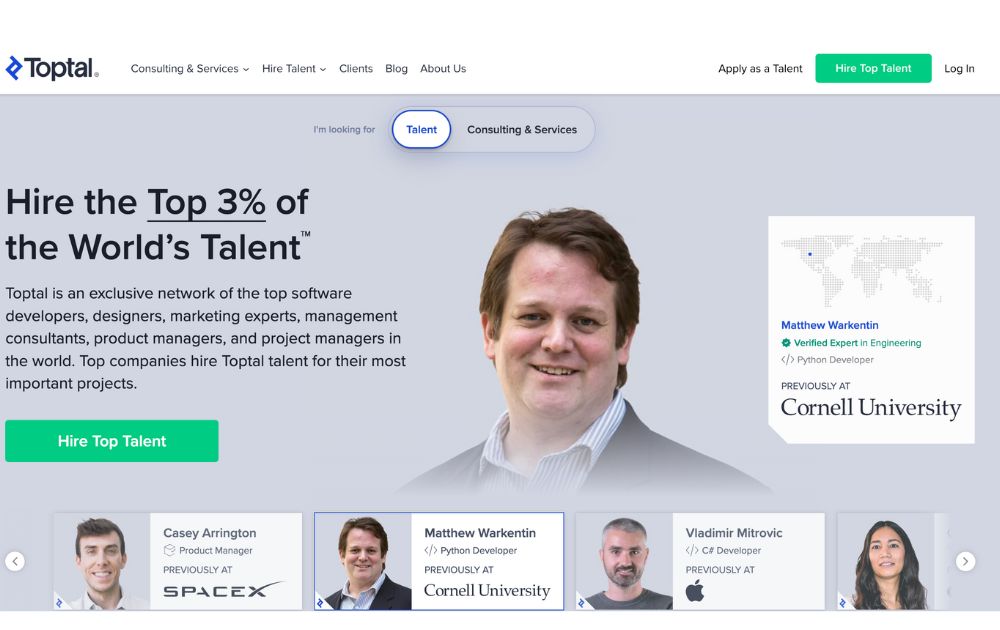
Trustpilot rating: 4.5
If you want to hire a freelancer, but you’ve been disappointed in the past, you might be hesitant to try again. Fortunately, Toptal has taken a different approach from platforms like Fiverr and Upwork. They offer a more upscale experience of freelance matching with highly experienced professionals (sometimes with impressive backgrounds like being a former Google employee). Many companies lean on Toptal for reliable freelancers, including Zendesk and DoorDash.
With Toptal, you can hire a freelancer part-time or full-time. You’ll simply answer a few questions about your business on their website. If you don’t like the work of the first designer you’re matched with in the early phase, Toptal will start the matching process over again so they can find you a better match.
Another benefit of Toptal is that they have professionals in various design niches. They offer UX and UI designers, product designers, game designers, creative directors, and more.
4. Webdew
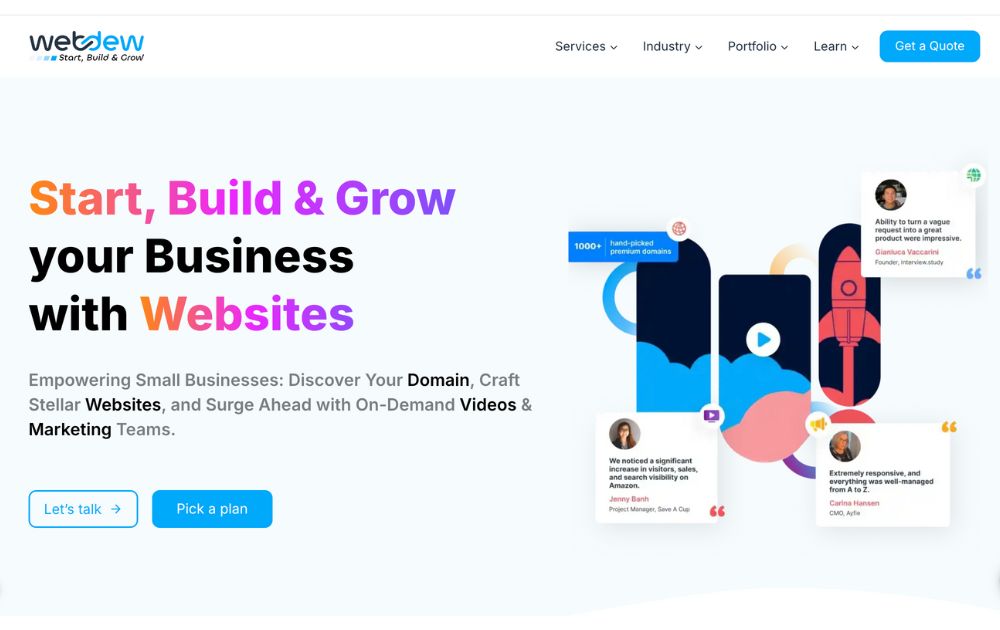
Trustpilot rating: 4.7
Webdew is a lesser-known company, but their review rating speaks for itself. Their skilled developers have a UI/UX focus and will take you through the entire design process from wireframe design to backend development. They also handle things like website migration and WordPress development.
Webdew is anything but a one-trick pony. They offer web design, video production, marketing, and Hubspot-related services. But if you’re looking for other graphic design services like logo design or illustration, you’ll have to look elsewhere.
5. DesignCrowd
Trustpilot rating: 4.6
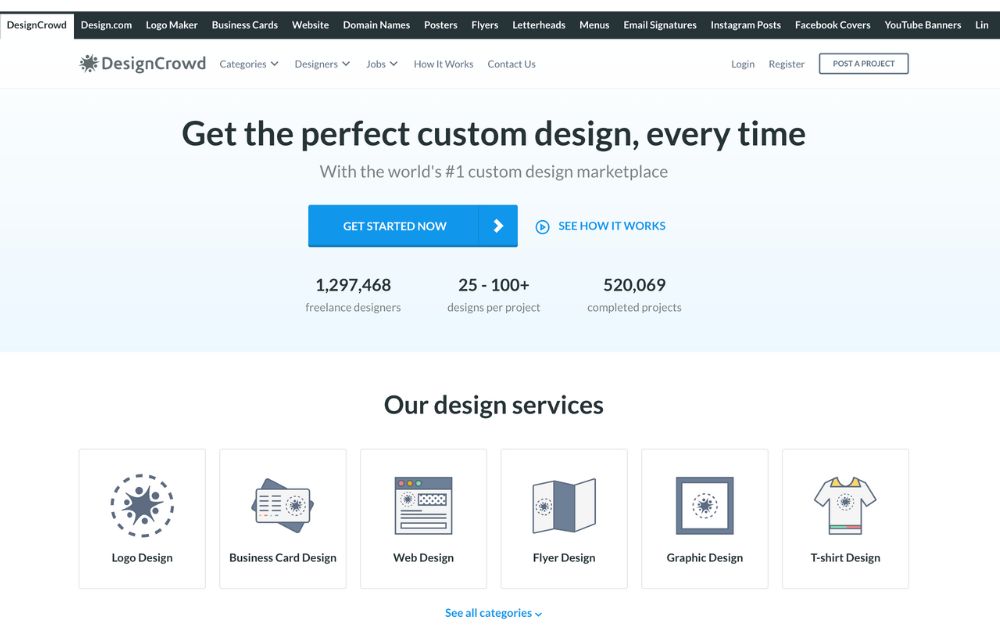
DesignCrowd is an innovative platform that connects businesses with freelance designers from around the world. By leveraging the power of crowdsourcing, DesignCrowd allows clients to post design projects and receive a wide variety of submissions from designers. This approach not only provides clients with creative options but also allows designers to compete on a global stage, showcasing their skills and gaining new opportunities. The platform covers many design mediums like logos, websites, and t-shirts, making it a versatile solution for enterprises of any size.
DesignCrowd’s process is straightforward and user-friendly. Clients start by outlining their design requirements and budget. This is then made visible to the platform’s extensive network of designers. Interested designers submit their concepts, and the client can provide feedback, request revisions, and ultimately choose their favorite design. The competitive environment encourages high-quality submissions, so you get great results. Additionally, they offer a satisfaction guarantee, so there’s no risk.
The value of signing up for an unlimited design service
1. Saves You Time
Hiring freelancers can take days or even weeks. You have to find the right person, check their availability, and direct them at each step of the design project. You can save time by subscribing to an unlimited graphic design service. These services have already done the vetting, which helps you cut the time needed to hire a freelancer & get usable work from them. These services have teams of designers with different skillsets, so you can simply swap designers if you don’t like the direction your project is going in.
2. Saves You Money
Some of the highest rated design services offer packages or bundles to help you save money that would be going to branding, social media managers, or ad creators. The design subscription model lets you pick to plan that offers only what you need and request multiple designs for a flat monthly fee. Unlimited revisions are built into the plan. So you’ll never pay extra fees or wait weeks for a simple project to be completed.
3. You Partner with Reliable Pro Designers
Since graphic design services manage the hiring process, they ensure the designers working for them are reliable and highly trained. Some freelancers are new to the industry, lack follow-through, or simply don’t know how to navigate professional conversations. Graphic design services guarantee that you’ll communicate directly with mature designers who respond to your requests and understand your vision.
4. You Double Your Design Output
For some companies, like agencies, design output is critical. You need many different types of design projects completed by specific deadlines. You also need to manage multiple brands, which unlimited design teams are accustomed to helping agencies do.
With free trials and money-back guarantees, there’s no risk in trying out one or all of the highest rated design services. You may just be surprised by how much work it takes off your team’s plate.



TL;DR – Even enterprises lose millions of dollars not from major product or investment failures but from operational issues hidden from plain sight, such as decision-making inefficiencies, workflow problems, execution and tech systems, and slow customer feedback integration.
Whatever the size of the business, operational efficiency is a crucial factor that spells the difference between a venture that thrives and one that bleeds. In fact, a study cited by Forbes revealed that companies lose 20% to 30% of revenue to process inefficiencies annually.
While it’s easy to assume that operational issues affect businesses more when they’re still at their initial growth phase, not many realize that these small inefficiencies could amplify consequences during scaling, when headcount, revenue, and investments grow fast.
In this article, let’s unpack five common operational areas where issues go unnoticed, causing even Fortune 500 companies millions of dollars. We’ll also discuss the best practices in each area to help optimize operations.
1. Decision Latency
How much time passes between identifying an issue in your organization and actually taking an action to address or correct it?
Oftentimes, enterprises have too many stakeholders, making it harder to align and make decisions fast. In addition, risk-avoidant companies typically push decisions upward, giving birth to a risk-escalation culture.

But does slower decision-making equal better decision-making? Not really. A survey by McKinsey & Company shows that people who spend more than one-third of their time and those who spend less reported the same effectiveness. The same survey reveals that 78% of respondents were involved in cross-cutting decisions, which typically require multiple approval layers.
It all boils down to a lack of a decision system design, which means repeated reviews, muddled accountability, and cross-functional dependency loops that could eat up time and other resources. How does it translate to real-world operational issues? Think project launch delays, missed market opportunities, and campaign schedule disruptions.
Best Practice: Build a decision design system that defines who should make and own which types of decisions. The design must also identify which decisions can go ahead without needing escalation.
2. Cross-Functional Hand-Offs
There are always opportunities for inefficiency within a department or team when all its parts are moving. This opportunity further widens when work moves across departments, regions, and even vendor arrangements.
Research by Deloitte on Global Business Services models shows that having a standard structure to unify cross-functional operations can reduce costs by 5 to 10%. Without such a unified structure, it means the company is missing potential efficiency gains of up to 10%.
At scale, the operational efficiency in this area can lead to duplication of work, loss of context, and delays between functions caused by poorly coordinated queues.
Best Practice: Design workflows that foster end-to-end accountability instead of workflows that pass through department boundaries. Doing so can help reduce cross-functional issues and improve speed.
3. Creative Execution and Production Workflows
Creativity doesn’t come cheap. A survey of over 1,000 businesses found the average monthly agency cost of social media marketing to be between $100 and $5,000, search engine optimization (SEO) at around $2,500, and content marketing falling at $5,001 to $10,000.
And these are just the regular businesses. Fortune 500 companies could potentially allot more resources for the production of creative assets, as well as campaign design and marketing assets.
And here’s where it can get tricky: expensive as it is already, creative execution and production can leak even more resources when there’s no clear creative workflow and regional offices recreate the same assets. It could also be the case when there’s an overlap between the work done by internal creative teams, agencies, and hired freelancers.

Most importantly, brands of all sizes risk suffering financially when there’s creative inconsistency. A 2024 UK study by System1, the Creative Effectiveness Platform, and the Institute of Practitioners in Advertising revealed that brands that didn’t focus on creative consistency needed to spend more to achieve the same growth as those that did. In fact, the cost gap is estimated at £3.47 billion.
System1 Global Partnerships Senior Vice President Andrew Tindall emphasized the data’s implication on businesses.
“…Brands win big on fame building, profit gain, market share gain and more when they foster a culture that supports creativity and consistency,” Tindall said in a statement.
Best Practice: Standardize the creative workflow and ensure that it’s centralized to reduce production timelines and improve creative consistency. Internal shared-service teams or design-as-a-service platforms like Penji can help streamline production and maintain consistent output.
4. Complexity Tax
Getting the latest AI solutions or adding something new to your tech stack regularly might seem productive, but it could be the opposite.
In fact, a study by Nexthink found that 49.96% of software installed in 2023 was unused by team members. This average spans 6 million customer environments in 12 regions, putting forward the question of sustainable efficiency.
However, pulling out from licenses altogether isn’t the solution and could even lead to higher costs that could quietly waste millions, according to Nexthink Chief Strategy and Marketing Officer Yassine Zaied.
“Only when IT has access to all the information about who is using what, what is not used, what is still performing and what needs to be repaired or replaced, can it see and take advantage of greater efficiencies in a sustainable and recurring manner,” Zaied said.
Best Practice: Design your tech ecosystem based on the value they offer around your workflow, and not based on maximizing the tools because they’re already available. By doing so, you can avoid redundant tools and improve tech adoption across teams.
5. Customer Feedback Integration Latency
Fortune 500 leaders have always been vocal about the importance of customer satisfaction.
As Michael L. Tipsord, the former CEO and Chairman of State Farm Insurance, once said, “Our success in serving our customers, that is what will ultimately determine the opportunities that are available to all of us.”
Walmart founder Sam Walton, meanwhile, famously said the customer is the boss.
“And he can fire everybody in the company from the chairman on down, simply by spending his money somewhere else,” Walton emphasized.
In an ideal business environment, customer feedback is part and parcel of product and service improvement. And rarely do enterprises lack data; the problem lies with integrating that data into their operations.

The American Customer Satisfaction Index 2025 Q3 results point to a broader systemic risk. While the national score remained flat at 76.9, it followed a period of decline and long-term stagnation. Analysts say this trend could potentially decouple buyer utility from seller profit, meaning companies may continue generating revenue without improving customer value.
Whether you’re managing a Fortune 500 company or a small business, one thing holds true: customer feedback is only valuable when you convert it into action in a timely manner.
Best Practice: Make sure your feedback systems move at the same speed as your customers. Treat feedback as a core part of your operating system and not a separate entity that’s only reviewed when the occasion presents itself.
Frequently Asked Questions (FAQs)
What is decision latency in simple terms?
Decision latency pertains to the time between identifying an issue and the time the company takes action to address such an issue.
Why are cross-functional hand-offs risky for large companies?
Cross-functional hand-offs can pose risks for enterprises because there’s always a chance for miscommunication, context misinterpretation, and work duplication. Such hand-offs can also make accountability harder to define clearly.
Why do Fortune 500 companies still experience operational inefficiencies?
Scale not only increases revenue and opportunities but also the complexities that come with it, especially when the inefficiencies that remain unnoticed between the processes multiply across teams and systems.
Featured Image Credit: Photo by Artem Podrez from Pexels


It’s a common misconception that efficiency comes naturally with increased organizational scale. For large enterprises, this is not true. More than half of the companies on the Fortune 500 list from 2000 are gone. Few of these failures can be attributed to a lack of resource availability they failed because of growing operational inefficiencies.
The threat posed by increasing inefficiency is not exclusive to failing organizations. Many of today’s most successful companies are still subject to it. The company’s size and complexity mask these inefficiencies, making it difficult to identify the source of corporate waste.
Below are five ways that even the most successful organizations are wasting value, and how others have overcome these operational flaws.
1. The “Zombie” Project Portfolio
Large organizations often solve the wrong problems with high-quality execution. This “signal blindness” happens when a company pours resources into optimizing a legacy process instead of reimagining the outcome. Blockbuster, for instance, didn’t ignore the market; it perfected its store layouts and late fee revenues. It solved for “retail efficiency” while the market pivoted to the “delivery efficiency” of streaming.
Today, this results in “zombie projects”—initiatives that are functional but strategically obsolete. They survive on executive sponsorship or the sunk cost fallacy. The corporate waste isn’t just the team’s salaries; it’s the opportunity cost. Every dollar spent optimizing a dying workflow is a dollar stolen from innovation.
2. Fragmented Creative Execution
As companies grow, their marketing and creative needs expand, often leading to a decentralized approach. One team hires a boutique agency for rebranding, another uses freelancers, while others rely on overworked in-house teams. This fragmentation creates a “creative tax”—paying premium rates for simple tasks and risking brand inconsistency when too many hands touch the visual identity.
To address this, forward-thinking companies are adopting systemized execution models. By auditing creative workflows, they categorize tasks by complexity; high-concept strategy stays with premium agencies, while high-volume work is streamlined. Platforms like Penji offer predictable, flat-rate workflows for routine design, reducing the need for managing multiple freelance contracts and ensuring faster execution.
3. Data-Rich, Insight-Poor Architectures
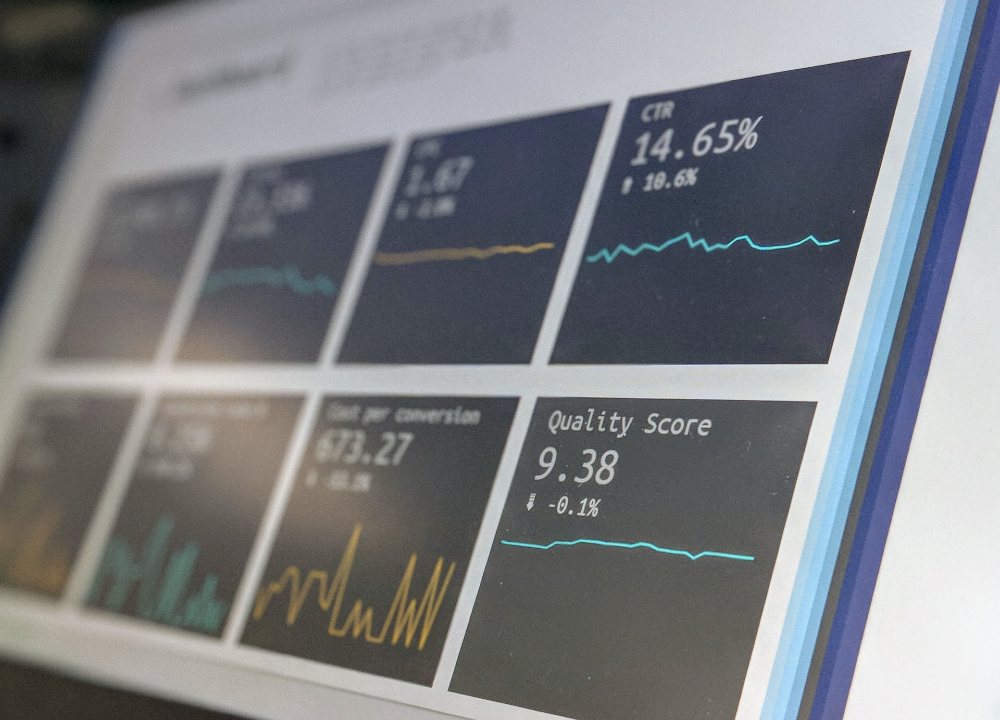
Many organizations believe that a lot of data equals intelligence (or innovative capacity), but this is an ineffective approach. Why pay for a system that makes it so information capture is more complicated because of too much or unnecessary information? For instance, why pay for a system that generates reports on vanity metrics, social media impressions, views of a website when no conversion value exists? It’s a waste of time, money and resources.
Analytics systems that fail to provide actionable insights result in data overload, where decision-makers struggle to separate what matters from what doesn’t. Truly efficient organizations prioritize actionable metrics that are directly tied to performance and strategy and limit unnecessary data collection. By doing so, they reduce the costs and complexities associated with storing and analyzing irrelevant information, ultimately enabling faster, more effective decision-making.
4. Capital Structure Inertia
Hidden inefficiencies can often be found in the structure of a company’s balance sheet. Over the years, Fortune 500 firms have steadily increased their reliance on debt, as seen in the rise of debt-to-total-assets ratios from 0.5% in 1950 to 20.4% in 2020. While leveraging debt can act as a growth engine, many firms fall into the trap of maintaining a static capital structure, regardless of market shifts or economic conditions.
For example, some companies hold excessive cash reserves that earn minimal value, while others continue to operate under high leverage even as interest rates climb. Failing to adjust debt-to-equity ratios to account for factors like inflation or widening credit spreads locks businesses into inefficient financing practices. Optimizing capital structure by aligning it with current economic conditions can help firms unlock trapped value and avoid unnecessary financial strain.
5. High-Friction Talent Utilization

One of the major inefficiencies in many large organizations is the poor use of human capital. The highest-level executives in many companies use their time for tasks that are not high impact for the organization. For example, someone in the Marketing Director role might spend several hours on each monthly report’s formatting and presentation. A VP of Sales might spend extensive time entering or updating customer relationship management data.
While all these tasks are necessary for a well-run company, having people with such high levels of expertise and experience carry out many of them is inefficient. Rather than hiring more staff to carry out these tasks, companies can take steps to reduce friction and inefficiencies in their day-to-day operations. For example, the company can use no-code automation tools to streamline processes.
The Shift to Operational Discipline
The most successful companies were not built by focusing on productivity gains for large organizations. This strategy yields diminishing returns when data demonstrates limited benefits from scaling workforce size and automation adoption.
They synthesized a unique challenge perspective and systemized execution strategy focusing on eliminating hidden operational cost sources. The companies that grow the next decade’s most significant will follow this example, making them ruthlessly efficient and hard to compete with.
Cover Image Credit: Photo by Karolina Grabowska on pexels


What’s the Best Design Agency in San Francisco?

5 Quiet Operational Leaks Costing Fortune 500s Millions

The Biggest Hidden Cost in Healthcare Isn’t Staff Time. It’s Operational Friction.

5 Things Even Fortune 500 Companies Quietly Waste Money On

The Biggest Hidden SaaS Cost Isn’t Ads—It’s Post-Click Execution

Top 10 Artificial Intelligence Solutions Your Business SHOULD Use

OpenStudio – Business Management All-In-One

How to Determine Which Social Network Is Right For Your Business

Know These Logo Statistics and Facts to Grow Your Business

How To Do Business Marketing For Free
OpenStudio – Business Management All-In-One
Top 10 Artificial Intelligence Solutions Your Business SHOULD Use

Here’s How You Can Scale Your Business Beyond a 7-Figure Revenue

What’s the Best Design Agency in Las Vegas?
 People2 days ago
The Biggest Hidden Cost in Healthcare Isn’t Staff Time. It’s Operational Friction.
- Business2 days ago
5 Quiet Operational Leaks Costing Fortune 500s Millions
- Uncategorized3 days ago
The Biggest Hidden SaaS Cost Isn’t Ads—It’s Post-Click Execution
- Business2 days ago
5 Things Even Fortune 500 Companies Quietly Waste Money On
- Uncategorized10 hours ago
What’s the Best Design Agency in San Francisco?


